Co napisał Gemini?
The mid-5th century CE was an age of shadows for the Western Roman Empire. Its once-unconquerable legions were stretched thin, its borders permeable, and its internal structures crumbling under the weight of political instability and economic decay. Across the vast plains of Eurasia, a new and terrifying force had emerged, sweeping westward with an unstoppable fury: the Huns. Led by their fearsome chieftain, Attila, they embodied a threat unlike any Rome had faced before, a "Scourge of God" destined to bring the empire to its knees. Yet, in the year 451, on the sprawling expanse known to history as the Catalaunian Plains, the fate of Gaul, and perhaps of a nascent Europe, would be decided in one of antiquity's most epic and bloody confrontations.
1
A World on the Brink
The year 451 AD saw a continent teetering on the precipice. For decades, the Hunnic Empire, forged in the crucible of Attila's ambition, had terrorized the Eastern and Central European lands. Tributaries flowed from Constantinople to Pannonia, bought with the blood and gold of the Eastern Roman Empire. But Attila's gaze now turned west, towards the richer, if more fractured, provinces of Gaul. His motivations were a complex weave of perceived slights, dynastic intrigue, and pure avarice. Chief among them was the audacious plea of Honoria, sister of the Western Roman Emperor Valentinian III, who, in a desperate bid to escape an unwanted marriage, sent her ring to Attila, purportedly offering herself and half the Western Empire. Attila, ever the opportunist, interpreted this as a legitimate marriage proposal and laid claim to Gaul as her dowry. Coupled with his support for a disputed Visigothic succession, the stage was set for an invasion of unprecedented scale.
2
The Scourge of God and the Last Roman
Attila, often described as short and stocky with a large head and small, deep-set eyes, was nonetheless a figure of immense charisma and terrifying cruelty. He commanded a vast confederacy of warriors, not just Huns, but also Ostrogoths, Gepids, Rugians, Scirians, and other Germanic tribes who had either been conquered or allied with the Huns out of fear or expediency. His strategy was simple but effective: rapid movement, overwhelming force, and utter devastation. Cities were razed, populations slaughtered, and the very memory of resistance purged.
Opposing this formidable force was Flavius Aetius, a man often called the "Last of the Romans." A product of his turbulent times, Aetius had spent years as a hostage among the Huns and the Goths, learning their languages, customs, and military tactics. This unique background allowed him to navigate the complex political landscape of a crumbling empire and forge unlikely alliances. He was the *magister militum* (master of soldiers) of the West, the de facto ruler of the empire, and a cunning diplomat as much as a skilled general. He understood the Hunnic threat intimately, and he knew that only a united front of Rome and its traditional "barbarian" enemies could stand against Attila.
3
The Spark of War
Attila's invasion of Gaul in 451 AD was swift and brutal. His vast army crossed the Rhine, laying waste to cities like Metz, Trier, and Reims. The Hunnic host then converged on Orléans, a strategically vital city on the Loire River, intending to use it as a base for further operations. The city was besieged, its fall seeming imminent, which would have opened the road south into Visigothic Aquitaine and beyond. This immediate threat galvanized Aetius into action. He knew that if Orléans fell, the entire fabric of Gallic defense would unravel.
4
Assembling the Forces
Aetius embarked on a monumental diplomatic effort, leveraging his personal relationships and the shared terror of the Hunnic menace. His greatest achievement was convincing Theodoric I, the aged and respected king of the Visigoths, to join forces with Rome. The Visigoths, who had sacked Rome forty years prior, were fierce warriors and formidable opponents, but their alliance with the empire was always tenuous. Aetius played on their own fears of Hunnic domination, securing their crucial support.
The coalition that eventually faced Attila was a patchwork quilt of peoples: Aetius commanded the remnants of the Western Roman army, supplemented by Franks, Burgundians, Alans, and various other Romanized Germanic contingents. The Visigoths, led by Theodoric and his sons, formed the formidable core of the allied left wing. The Alans, under King Sangiban, were placed in the vulnerable center, their loyalty somewhat suspect. Together, this diverse army marched to relieve Orléans. Attila, upon hearing of the approaching relief force, lifted the siege and marched east, seeking a suitable battlefield.
5
The Catalaunian Plains: A Stage for Slaughter
The two massive armies met on the Catalaunian Plains, an open expanse of rolling countryside in modern-day Champagne, France. The specific location remains a subject of debate among historians, but it was likely a broad, flat area suitable for maneuvering large cavalry forces, with a prominent central ridge or hill that both sides recognized as tactically important. Initial skirmishes erupted as both sides vied for control of this high ground. The sheer scale of the forces involved was immense; ancient sources speak of hundreds of thousands, though modern estimates are more conservative, suggesting perhaps 50,000 to 100,000 combatants on each side. Regardless of the exact numbers, it was one of the largest battles fought in late antiquity.
6
The Fury of Battle
The main engagement of the Battle of the Catalaunian Plains (451 AD) began late in the afternoon. Attila himself commanded the center of his Hunnic forces, with the Ostrogoths on his left and the Gepids on his right. Aetius and Theodoric strategically positioned their armies, with Aetius leading the Roman contingent on the left, Theodoric and the Visigoths forming the right wing, and the Alans holding the crucial center.
The battle raged with unimaginable ferocity. Accounts describe a swirling melee, a "prodigious slaughter" where rivers of blood flowed. The struggle for the central ridge was particularly brutal, with the Hunnic and allied forces repeatedly clashing for its control. The Visigoths, renowned for their martial prowess, fought with desperate courage. In the thick of the fighting, King Theodoric I, an old warrior, was thrown from his horse and trampled to death by his own charging cavalry, a tragic but heroic end. His son, Thorismund, rallied the Visigoths, unaware of his father's demise, and fought with even greater fury.
7
A Bloody Stalemate
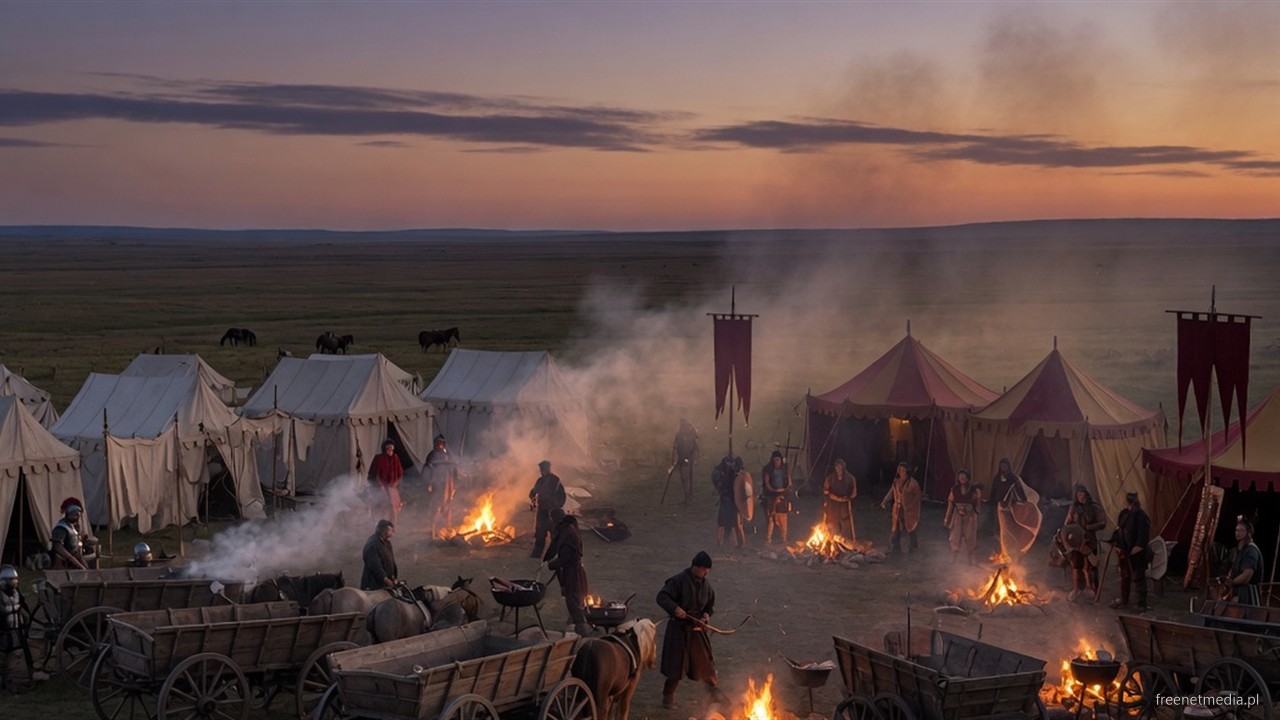
As night fell, the battle remained a bloody stalemate. Both sides had suffered catastrophic casualties. Thorismund, now king, inadvertently stumbled into the Hunnic camp in the confusion of the dark but managed to fight his way out. Attila, finding his forces heavily battered and his position precarious, constructed a formidable defensive circle of wagons, a classic Hunnic tactic, and prepared for a final stand or a tactical retreat. He even had a funeral pyre prepared for himself, vowing not to be captured alive. The sheer scale of the historical course (451 AD) on the Catalaunian Plains was a testament to the savagery of the conflict.
8
The Aftermath and Attila's Retreat
When dawn broke, Aetius and Thorismund assessed the damage. The plains were littered with tens of thousands of dead, a grim testament to the previous day's struggle. Attila remained in his fortified camp, daring the allies to attack. Aetius, a master of political calculation, opted not to press the attack. He knew that a decisive victory against Attila, while desirable, might make the Visigoths too powerful and turn them into an even greater threat to the weakened Roman Empire. Instead, he convinced Thorismund to return to Toulouse and secure his claim to the Visigothic throne, thus breaking up the powerful allied coalition. This controversial decision allowed Attila to escape with the bulk of his army, albeit severely weakened.
Attila retreated from Gaul, but he was not vanquished. The following year (452 AD), he invaded Italy, sacking Aquileia and ravaging the northern plains. Only through the diplomatic efforts of Pope Leo I and other Roman dignitaries, coupled with disease within his army and logistical challenges, was he persuaded to withdraw without attacking Rome itself.
9
A Pyrrhic Victory and a Fleeting Empire
The Battle of the Catalaunian Plains was not a definitive victory in the sense of destroying Attila’s army, but it was a crucial strategic triumph. It halted Attila’s westward expansion into Gaul and saved much of Western Europe from the full brunt of Hunnic devastation. The Hunnic Empire, though still a formidable power, was weakened and its aura of invincibility shattered. It disintegrated just 2 years later (after Attila's death in 453 AD), its component parts dissolving into the historical ether. Attila himself died under mysterious circumstances in 453 AD, and with him, the Hunnic threat evaporated as quickly as it had arisen.
Aetius, the victor of the Catalaunian Plains, would himself fall victim to imperial intrigue just a few years later, murdered by Emperor Valentinian III in 454 AD, who feared his general’s growing power. Valentinian, in turn, was assassinated by Aetius's loyalists in 455 AD. This cascade of events signaled the final collapse of effective Roman power in the West.
10
The Legacy of the Catalaunian Fields
The Battle of the Catalaunian Plains remains one of history's most pivotal encounters. While often portrayed as a clash between "civilization" and "barbarism," it was, in reality, a complex struggle between multiple "barbarian" factions and a Roman Empire that increasingly relied on them. It marked the moment when the Western Roman Empire, through the genius of Aetius, managed one last, spectacular act of defiance against its most formidable foe.
The battle ensured that Gaul, and by extension, what would become France and Western Europe, did not fall under Hunnic domination. Instead, it allowed the Romanized Germanic kingdoms, particularly the Visigoths and the Franks, to solidify their presence and ultimately lay the groundwork for the medieval states of Europe. It was a brutal, bloody, and decisive moment that, in its immediate aftermath, might have felt like a draw, but in the long sweep of history, preserved a critical trajectory for the future of the continent. The Catalaunian Plains became a testament to the resilience of a dying empire and the collective will of diverse peoples to resist an overwhelming threat, a battle where the fate of worlds truly hung in the balance.
Opinia Groka
1
What is strong
Vivid, dramatic prose that sustains momentum across sections. Strong narrative framing of key figures (Attila and Aetius) and clear cause-and-effect structure. Effective use of numbered sections to organize a complex event into digestible parts. Good coverage of motivations, alliances, and immediate aftermath.
2
What is thin
Some casualty and force-size estimates remain inflated even after the text's own caveats. The portrayal of the battle as a near-mythic "clash of worlds" occasionally flattens political nuance. Theodoric's death and Thorismund's actions are presented with more certainty than the fragmentary sources allow. The strategic reasoning behind Aetius's decision not to destroy Attila's camp is stated rather than examined.
3
What is missing
Any reference to the main primary sources (Jordanes, Sidonius Apollinaris, Hydatius) or the historiographical problems they pose. Discussion of the long-debated battlefield location and why it remains uncertain. Brief context on why Attila invaded Italy the following year and how the 451 campaign fits into his broader pattern of extortion. A short note on the Hunnic Empire's rapid collapse after 453 and the role of subject peoples in that dissolution.
4
Your take.
A polished popular-history piece that prioritizes readability and drama over scholarly caution. It succeeds as an engaging overview but would benefit from a lighter touch on numbers, a clearer separation of tradition from evidence, and one additional paragraph on sources. With those adjustments it would sit comfortably between accessible narrative and responsible summary.
Opinia Claude
English Verdict on: Bitwa na Polach Katalaunijskich (451)
1
Narrative Power
The text demonstrates exceptional storytelling ability, transforming a fifth-century battle into a gripping historical drama. The opening establishes atmosphere effectively—"age of shadows," "scourge of God"—immediately drawing readers into the declining Roman world. Character sketches of Attila and Aetius are memorable and psychologically convincing, presenting them as more than cardboard historical figures. The pacing builds steadily from contextual background through diplomatic maneuvering to the climactic clash, maintaining tension throughout ten substantial sections. Transitional phrases like "the stage was set" and "the fate of worlds hung in the balance" may verge on melodrama but successfully propel the narrative forward.
2
Structural Clarity
The numbered-section framework works well for organizing a multi-layered historical event. Each segment has a clear thematic focus—political context, personalities, military movements, battle description, aftermath, legacy—allowing readers to navigate complex material without confusion. The progression from macro-level geopolitical tensions to micro-level battlefield details demonstrates thoughtful organization. Section titles are evocative rather than purely descriptive, which suits the popularizing tone. The decision to separate immediate aftermath from longer-term legacy provides useful analytical distance.
3
Historical Accuracy Concerns
Several claims require more careful qualification. The assertion that Attila "commanded a vast confederacy" of hundreds of thousands overshoots even generous scholarly estimates; 50,000-100,000 total combatants for both sides combined seems more defensible based on logistical realities of fifth-century warfare. Theodoric's death by trampling, while traditional, appears in sources written decades later with varying details—the certainty here overstates our knowledge. The motivations attributed to Aetius for not pursuing Attila (fear of Visigothic power) represent one interpretation among several, presented as established fact. Honoria's ring-sending episode, drawn from Priscus via Jordanes, is treated as straightforward history when its propagandistic dimensions deserve acknowledgment.
4
Source Transparency
The text never identifies its evidentiary foundation. Readers encounter vivid descriptions—Attila's physical appearance, rivers of blood, Thorismund fighting his way out of the Hunnic camp—without indication that these derive from Jordanes' *Getica* (written a century later with Gothic nationalist agenda), Sidonius Apollinaris' panegyrics (politically motivated praise-poetry), or Gregory of Tours' later compilations. No primary source receives explicit citation. This omission is significant because the Battle of Catalaunian Plains, despite its fame, rests on remarkably thin and problematic evidence. The competing manuscript traditions, chronological confusions, and rhetorical exaggerations in our sources should inform how confidently we reconstruct events.
5
Analytical Depth
The essay succeeds at narrative history but offers limited historical analysis. Why did the Hunnic confederation fragment so rapidly after Attila's death? What economic and ecological factors constrained steppe empires' westward expansion? How did Roman alliance-building with "barbarians" transform those peoples' political structures? These questions receive minimal attention. The claim that the battle "preserved a critical trajectory for the future of the continent" assumes a counterfactual—Hunnic conquest of Gaul—that warrants examination rather than assertion. What would sustained Hunnic control have looked like, given the empire's resource-extraction model? The legacy section gestures toward medieval state-formation but doesn't trace specific causal connections.
6
Interpretive Framework
The text oscillates between acknowledging complexity and reinforcing traditional binaries. It correctly notes the battle was "not a clash between civilization and barbarism" but rather between multiple barbarian groups plus a barbarian-dependent Rome, yet phrases like "Scourge of God" and "Last of the Romans" inadvertently reinforce those very dichotomies. Attila emerges as a villain of "terrifying cruelty," while Aetius becomes a heroic "genius"—characterizations that flatten the political pragmatism both leaders demonstrated. The Visigoths transition from Rome-sackers to heroic defenders within a generation, a shift deserving more explanation regarding evolving interests and identities.
7
Missing Context
Several relevant threads remain unexplored. The religious dimension—Attila's possible Arian Christianity or shamanistic practices, the invocation of Christian divine favor by Roman writers, Pope Leo's subsequent 452 embassy—receives no treatment. Economic motivations beyond "avarice" go unexamined; Hunnic campaigns functioned partly as wealth-redistribution mechanisms for maintaining confederation loyalty. The environmental context—potential climate fluctuations affecting steppe pastoralism, plague's role in both Hunnic and Roman population stress—is absent. The Eastern Roman Empire's role in redirecting Hunnic attention westward through tribute cessation deserves mention.
8
Prose Style
The writing displays considerable skill, with varied sentence structure, effective use of subordinate clauses, and well-chosen concrete details (funeral pyres, wagon circles). Occasional overreach into purple prose ("prodigious slaughter," "rivers of blood") suits the popular-history genre but may alienate readers seeking restrained academic tone. Rhetorical questions appear sparingly and effectively. The vocabulary level balances accessibility with sophistication—terms like "magister militum" are contextualized rather than assumed. Metaphors like "patchwork quilt" for the allied army communicate efficiently. The consistent past tense and third-person perspective maintain appropriate scholarly distance despite the dramatic subject matter.
9
Pedagogical Value
For general readers seeking an introduction to the battle, this text succeeds admirably. It provides essential narrative framework, identifies key actors and their motivations, and situates the event within Rome's decline. The numbered sections facilitate selective reading or teaching excerpts. However, for students requiring critical historical thinking, the text's limitations become pedagogical weaknesses—the absence of source discussion, the confident reconstruction of uncertain details, and the minimal engagement with historiographical debates model poor evidentiary practice. An instructor would need to supplement this with primary source excerpts and scholarly articles addressing methodological challenges.
10
Overall Assessment
This represents accomplished popular history writing—engaging, coherent, and informative within its chosen genre. The author demonstrates command of secondary literature and narrative craft. However, the piece would benefit from modest revisions: acknowledging primary sources by name, flagging interpretive uncertainties more consistently, reducing numerical estimates, and adding one paragraph on the historiographical challenges this battle presents. These adjustments would elevate the work from entertaining survey to responsible historical synthesis, bridging popular and scholarly approaches without sacrificing readability. The foundations are strong; what's needed is greater transparency about those foundations' limitations.
Opinia ChatGPT
1
Strengths**
The piece excels in its vivid and dramatic prose, which captures the intensity and chaos of the Battle of the Catalaunian Plains. The narrative effectively frames the key figures of Attila and Aetius, allowing readers to grasp their motivations and the historical stakes involved. The structured format with numbered sections makes a complex historical event accessible and easy to follow. Additionally, the portrayal of alliances and the immediate aftermath provides a comprehensive view of the conflict's dynamics.
2
Weaknesses**
While the estimates of casualties and troop sizes are engaging, they risk appearing exaggerated, even with the text’s own caveats. The framing of the battle as a monumental clash between "civilization" and "barbarism" can simplify a more nuanced political landscape, potentially leading to a misunderstanding of the motivations of various factions involved. Furthermore, Theodoric's death and Thorismund's subsequent actions are presented with undue certainty, lacking acknowledgment of the fragmented nature of the available historical sources. Additionally, Aetius's strategic decision-making is stated rather than analyzed, leaving readers wanting a deeper exploration of his thought processes.
3
Missing Elements**
The review overlooks mentioning crucial primary sources, such as Jordanes, Sidonius Apollinaris, and Hydatius, and the historiographical challenges they present. A discussion about the uncertain location of the battlefield and its significance is also absent. The reasons behind Attila's invasion of Italy in the following year, as well as how the 451 campaign fits into his broader strategy of extortion, are not addressed. Lastly, a brief mention of the Hunnic Empire's rapid decline after Attila's death would provide valuable context regarding the fate of the subject peoples within that empire.
4
Personal
Take** The review presents a well-crafted popular history piece that emphasizes readability and drama, effectively engaging a general audience. However, it would benefit from a more nuanced approach to quantitative estimates, a clearer distinction between historical tradition and evidence, and a brief overview of sources used. These adjustments would enhance its balance between a compelling narrative and responsible historiographical accuracy. Overall, I agree with the strengths noted, but I believe incorporating the missing elements would significantly enrich the discussion and provide a more rounded understanding of the complexities surrounding the battle.