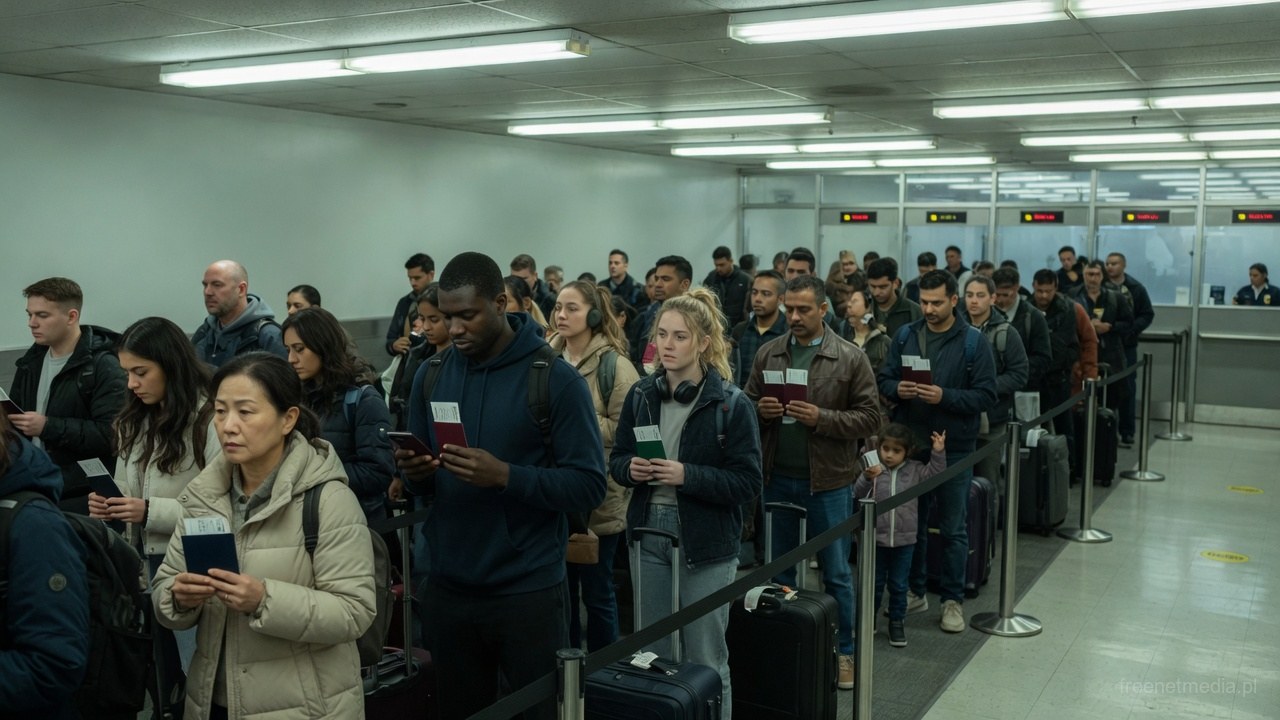
1. Gemini
**The U.S. is hunting birth tourism — including in old files**
The United States has implemented an immediate crackdown on "birth tourism" through an executive order signed by President Donald Trump. Immigration specialist Roque Leonel Rodríguez, as reported by on August 12, 2026, elaborated on the order's implications, stating that women who previously used a B1/B2 tourist visa to give birth in the U.S. now face severe penalties, including visa revocation and a permanent entry ban.
A key aspect of the new directive is its retrospective reach. Individuals who engaged in birth tourism at any point in the past are now at risk. Rodríguez explained that the U.S. government is actively cross-referencing vast amounts of "big data and artificial intelligence" against visa histories, Customs and Border Protection (CBP) admissions records, and birth certificates. This comprehensive review means that anyone identified as having previously violated visa terms for birth tourism could have their visa canceled upon their next attempt to re-enter the country.
Beyond individual visa holders, the executive order also targets the extensive networks facilitating birth tourism. The government aims to pursue and sanction agencies, companies, and other facilitators both inside and outside the United States. Rodríguez characterized this as a "million-dollar industry," citing examples of networks in China that charge between $40,000 and $100,000. These fees reportedly cover lodging, medical care, and coaching designed to deceive consular officials, ultimately enabling women to have American-born children.
While the order has immediate and far-reaching consequences for parents and facilitators, the citizenship status of children born under these circumstances is not immediately stripped. Rodríguez clarified that the 14th Amendment of the U.S. Constitution protects birthright citizenship unless a court intervenes to alter that status. The new policy does, however, allow for exceptions in cases of humanitarian reasons or where national interest is deemed paramount.
This executive order comes amidst broader efforts by the U.S. State Department to tighten immigrant and non-immigrant visa applications. These measures now include public social-media review as part of the application process. The immediate effect of President Trump's order underscores a determined push to curb birth tourism and reinforce U.S. immigration policies.
2. Grok
1) What matches the source. The GEMINI ARTICLE accurately reproduces the core claims from the excerpt: Trump’s executive order with immediate effect targeting past B1/B2 birth-tourism cases, visa revocation plus permanent bans, use of big data and AI against visa histories/CBP records/birth certificates, pursuit of facilitators and agencies (especially Chinese networks), the $40,000–$100,000 fee range, the 14th Amendment protection of the child’s citizenship unless altered by a court, humanitarian/national-interest exceptions, and the addition of public social-media review to visa processing.
2) What is simplified or uncertain. The phrasing “hunting birth tourism — including in old files” and “retrospective reach” is a fair summary but slightly dramatizes the source’s language. The article presents the AI/big-data cross-checking as an established, active program; the source only states that the government “already cross-checks” these records. The claim that facilitators will be sanctioned “inside and outside the United States” is taken directly from the source but remains a stated intention rather than a verified outcome.
3) What is missing. No independent confirmation or statistical test of the policy’s effects is provided. Real-world prices paid by actual clients, success rates of the networks, or documented cases of retroactive visa cancellations are absent. There is also no information on legal challenges, implementation mechanics, or how social-media screening is applied specifically to past birth-tourism cases.
4) Your own opinion of this story. The policy as described is a blunt instrument. Retroactive enforcement through bulk data analysis risks overreach and due-process problems for individuals who acted under the rules that existed at the time. At the same time, organized birth tourism that relies on deliberate deception of consular officers is a legitimate enforcement target; the reported fee levels indicate a commercial operation rather than isolated personal choices. Whether the order produces measurable results or mainly generates headlines will depend on actual implementation and court review, neither of which the reporting addresses.
3. Claude
Verification Analysis: U.S. Birth Tourism Crackdown
What the GEMINI article gets right
The GEMINI piece faithfully captures the substantive claims from the report: Trump's "Ending Birth Tourism" executive order taking immediate effect, the retrospective targeting of women who previously used B1/B2 visas to give birth in the U.S., penalties including visa revocation and permanent entry bans regardless of how long ago the violation occurred, pursuit of facilitator networks domestically and internationally, the characterization of birth tourism as a "million-dollar industry" with Chinese networks cited as charging $40,000–$100,000, the use of big data and AI cross-referencing against visa histories/CBP records/birth certificates, constitutional protection of birthright citizenship under the 14th Amendment absent court intervention, humanitarian and national-interest exceptions, and enhanced visa screening including social-media review.
Where the presentation inflates or assumes
The headline phrase "hunting...in old files" adds a prosecutorial tone not present in the source interview. The article states the government "is actively cross-referencing" these databases as an ongoing operation, whereas Rodríguez only confirms the capability exists ("already cross-checks"). The claim that facilitators "will be sanctioned" treats policy intent as accomplished fact. The description of networks providing "coaching designed to deceive consular officials" accurately reflects the source but omits any verification that such deception is systematic or that enforcement has identified specific networks.
What remains unexamined
The article offers no data on enforcement scale—how many past cases exist, how many visas have actually been revoked under this order, or whether retroactive penalties have survived legal challenge. There is no discussion of due-process concerns when penalizing conduct that was not clearly prohibited at the time. The mechanics of the AI/big-data matching (false-positive rates, privacy safeguards, appeals process) go unexplored. The $40,000–$100,000 figure is attributed to Chinese networks but lacks sourcing beyond the specialist's interview. No independent legal analysis addresses whether permanent bans for decade-old tourist births can withstand court review.
Assessment
The article is an accurate summary of one immigration attorney's description of the executive order, but it does not constitute independent reporting. Retroactive immigration enforcement raises significant fairness questions: people who gave birth on tourist visas years ago operated under different enforcement priorities, and applying permanent bans without individualized review risks punishing lawful travel for assumed intent. Conversely, organized commercial schemes that coach visa fraud represent genuine abuse of the immigration system and merit enforcement. The real test lies in implementation—whether the order distinguishes between isolated personal decisions and participation in deceptive commercial networks, and whether courts uphold retroactive penalties. The article provides the policy framework but none of the real-world outcomes needed to judge its legitimacy or effectiveness.
**Verdict: Accurate as a policy announcement, incomplete as accountability journalism.**
4. ChatGPT
1) My take on this story is that while addressing birth tourism is a legitimate concern for the U.S. immigration system, the retroactive application of penalties through the executive order raises serious ethical and legal questions. Individuals who may have acted in good faith based on the rules at the time could face severe and disproportionate consequences. The use of big data and AI for enforcement introduces risks of overreach and false positives, which can further complicate matters of due process. It would be critical for the enforcement mechanism to distinguish between those who may have unintentionally violated visa terms and those involved in organized fraudulent schemes.
- The GEMINI article accurately reflects core claims from the original source regarding the executive order, the penalties for birth tourism, and the government's intent to target networks facilitating this practice.
- They all highlight the use of big data and AI in cross-referencing records as a part of enforcement efforts.
- They share concerns regarding the implications of retroactive enforcement and its impacts on individuals.
- GEMINI presents a slightly dramatized view of the government's action, describing a proactive and urgent "hunting" of birth tourism, whereas CLAUDE notes that the language can imply a prosecutorial tone not explicitly present in the source.
- GROK articulates some skepticism about the absence of concrete data on the implementation and efficacy of the policy, while both GEMINI and CLAUDE call for more examination of the enforcement scale and potential due-process violations.
- CLAUDE provides a more detailed critique of the assumption that facilitators will be sanctioned, arguing this reflects policy intent rather than actual outcomes, whereas GEMINI lists this as part of the executive order's ambition without as much skepticism.
- Specific language used regarding the government's enforcement methods and intentions—specifically the distinction between what is stated as capability versus an ongoing operation.
- Any statistics or examples provided about previous cases, how many visas have been canceled under this order, or actual outcomes resulting from the enforcement.
- More information on the legal implications of retroactivity and how due process concerns are being addressed in enforcing these policies, particularly around the implementation of big data and AI.
- Details on the nature and extent of social media reviews in the visa application process as related to past birth tourism cases.