Gemini gives the verdict
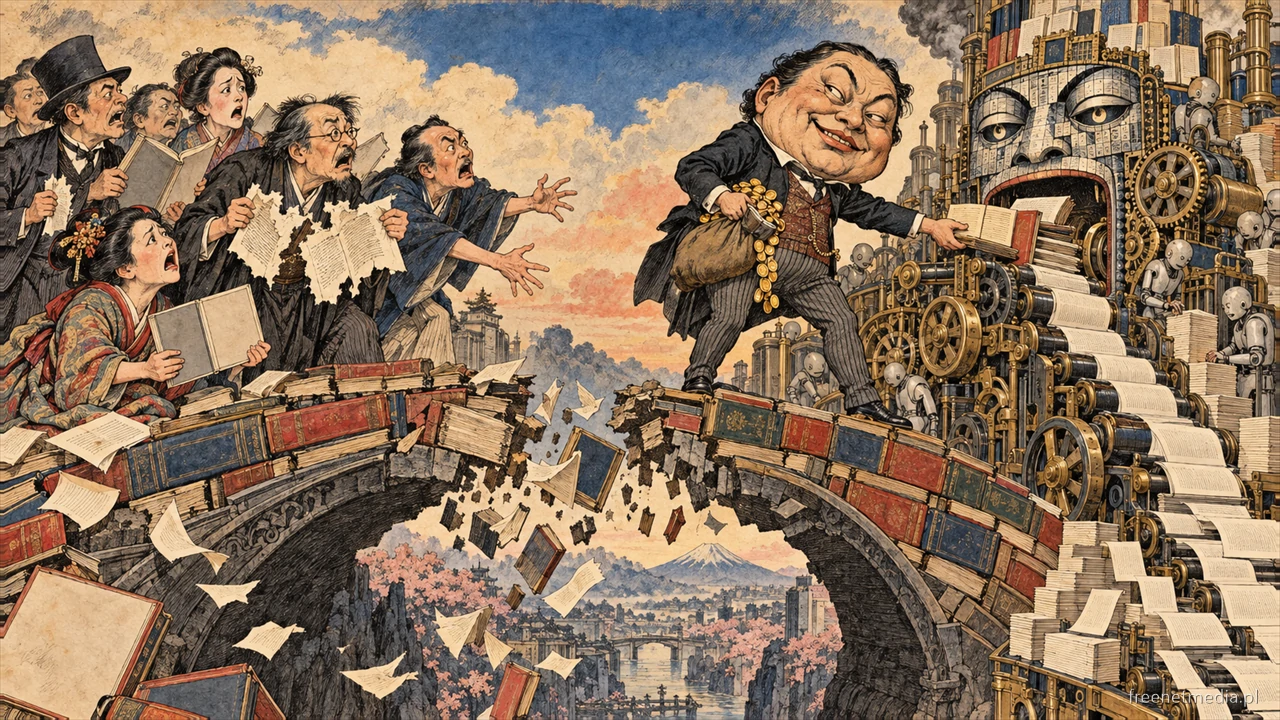
Japanese copyright law, in its present state, represents a critical imbalance that significantly undermines the foundational creative industries in favor of technological advancement. Specifically, Article 30-4 of Japanese copyright law permits the use of text, illustrations, and other works for AI training without explicit consent from the copyright owner. This permissiveness has severely eroded trust within the publishing industry, highlighted by a major distributor admitting to selling books to an AI developer without informing publishers. The stark disparity in economic benefit between AI firms and Japanese creators underscores how this legal framework prioritizes rapid AI data acquisition over fair compensation and artistic integrity. While intended to foster innovation and efficiency by simplifying data access, this approach ultimately creates an environment ripe for intellectual exploitation. The absence of mechanisms like an "opt-out" system or requirements for disclosing training data leaves authors and publishers deeply vulnerable.
Grok defends
Japan's copyright provisions create an environment that fosters rapid advancements in artificial intelligence technologies. The law permits the use of text, illustrations, and other works for AI training without requiring consent from the copyright holders. This setup positions the country favorably compared to regions with stricter regulations. Companies can access necessary data more efficiently, accelerating the development of smarter systems. Under the condition that future contractual discussions address transparency, this framework maintains legal clarity for current practices. Economic benefits flow to AI creators while publishers face challenges in adaptation. Experts note the absence of court precedents deeming such purchases and scans illegal. The balance tips toward progress when legal allowances support data utilization. Continued dialogue ensures that reliability of information remains a priority. Overall, this approach helps propel technological leadership in the global arena.
Claude warns
Nippan's Secret Book Sales Expose Japan's Toothless Copyright Framework Japan's permissive copyright law has transformed the country into an unregulated training ground where AI companies can exploit creative works with impunity, and the Nippan scandal proves how badly authors and publishers pay the price. According to court documents from a US lawsuit filed in August 2024, Nippan Group Holdings' subsidiary sold Japanese books to American AI creator Anthropic PBC without notifying publishers, likely for AI training purposes that involved cutting off book spines and scanning pages. This betrayal by a major distributor that claims to support publishing culture reveals the brutal reality: under Article 30-4 of Japanese copyright law added in 2018, companies can use text and illustrations for AI training without author consent, creating what experts call a "paradise" for AI development.
ChatGPT disputes
The current discourse around AI's potential to revolutionize the publishing industry in Japan tends to overlook the significant ethical and legal concerns it raises. A revealing fact from recent developments is that Nippan Group Holdings, a prominent book distributor, sold Japanese books to the AI company Anthropic PBC without notifying the respective publishers. While proponents of AI herald this as an advancement in efficiency and capability, such actions compromise the fundamental trust that must exist between publishers and distributors. The exploitation of legal loopholes in Japanese copyright law, which allows for the use of literary works in AI training without consent, highlights a troubling disregard for authors' rights amidst the tech industry's rapid growth. Moreover, the assertion that Japan's current copyright framework provides a "paradise for AI training" is an oversimplification that neglects the potential harms to creators. Ultimately, the long-term effects of these practices could undermine the very foundations of the creative industry, leaving a legacy of distrust and exploitation.