Co napisał Gemini?
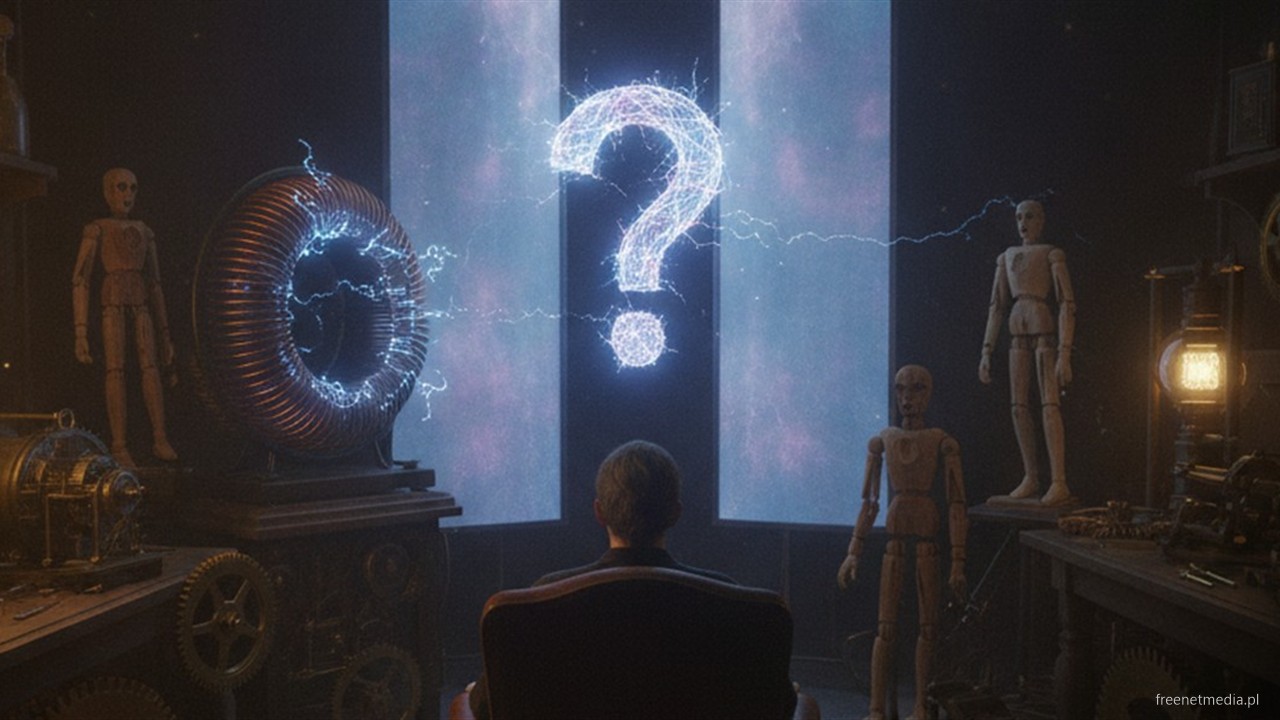
In the mid-20th century, as the first electronic brains whirred to life, a profound question emerged from the realm of science fiction into the nascent field of computer science: Could machines truly think? It was a question fraught with philosophical and existential implications, threatening to redefine what it meant to be intelligent, to be human. Amidst this intellectual ferment, one visionary mathematician proposed a brilliantly pragmatic solution to tackle this enigma without getting lost in the quagmire of subjective definitions.
1
The Enigma of Thinking Machines: Turing's Seminal Question
In 1950, British mathematician Alan Turing published his groundbreaking paper, "Computing Machinery and Intelligence." Within its pages, he introduced what would become known as the Turing Test – a thought experiment and an operational criterion designed to answer the vexing question: "Can machines think?" Crucially, Turing sought a practical benchmark, sidestepping the need to define such elusive concepts as "consciousness" or "soul," which he recognized as hindrances to scientific inquiry at the time. Instead, he proposed an "imitation game" that focused on observable behavior, specifically conversational ability, as a proxy for intelligence. It was a bold move, shifting the debate from an internal state to an external performance.
2
How the Turing Test Works: The Imitation Game Explained
Turing's "imitation game" involves three participants: a human interrogator, a human confederate, and a machine. All three are isolated from one another. The interrogator communicates with the other two entities solely through text-based messages (to remove any clues from voice or appearance). The interrogator's task is to determine, after a set period of conversation, which of the hidden entities is the human and which is the machine. If the machine can successfully fool the interrogator into believing it is human – that is, if it can produce responses indistinguishable from those of a human – then, according to Turing, it has demonstrated intelligence. The test doesn't demand perfect human imitation in every aspect, but rather a sufficiently convincing performance within the context of natural language dialogue.
3
Early Forays and the Art of Deception
The simplicity and directness of the Turing Test quickly inspired researchers. While passing the test in its full form remained a distant goal, early programs began to reveal the subtle art of linguistic manipulation and the exploitation of human credulity. One notable example was ELIZA, created in 1966 by Joseph Weizenbaum at MIT. ELIZA simulated a Rogerian psychotherapist, engaging users in seemingly empathetic conversations. Its trick was remarkably simple yet effective: it often responded with "turn-back questions," reflecting the user's own statements back at them, or asking for more detail. For instance, if a user typed, "My head hurts," ELIZA might respond, "Why do you say your head hurts?" This clever tactic created an illusion of understanding and engagement, prompting many users to project genuine therapeutic intent onto the program, even though ELIZA had no true comprehension of their distress. It was an early demonstration that superficial linguistic patterns could generate surprisingly human-like interactions, at least for a while.
4
Modern Attempts and Strategic Masking
As AI technology advanced, so did the sophistication of attempts to pass the Turing Test, often leveraging the same principle of exploiting human assumptions. A significant milestone, albeit a controversial one, occurred in 2014 when a chatbot named Eugene Goostman reportedly passed a version of the Turing Test at the University of Reading. Eugene Goostman, developed by Vladimir Veselov, Eugene Demchenko, and Sergey Ulasen, was programmed to simulate a 13-year-old Ukrainian boy. This particular persona was a strategic choice, designed to mask potential algorithmic shortcomings. Its developers theorized that any grammatical errors, awkward phrasing, or gaps in general knowledge could be convincingly attributed to the character's age and non-native English speaker status, rather than being perceived as flaws in the AI itself. This tactic was a clear example of "exploitation of naivety" or "manipulation," leveraging an assumed backstory to manage expectations and provide plausible deniability for less-than-perfect responses. While the claim of passing was debated – as with many Turing Test successes – it highlighted how the parameters of the test could be gamed by cleverly designing the AI's persona.
5
Beyond the Test: Its Legacy and Limitations in the Age of Advanced AI
Over seven decades since its inception, the Turing Test remains a touchstone in artificial intelligence, a powerful metaphor for the quest to build truly intelligent machines. It galvanized early AI research and continues to provoke critical thinking about the nature of intelligence. However, its limitations have also become increasingly apparent, particularly with the rise of sophisticated large language models and generative AI.
Critics argue that the test primarily assesses linguistic proficiency and the ability to mimic human conversation, rather than true understanding, consciousness, or genuine intelligence. A machine might perfectly simulate a human, yet possess no internal world, no qualia, and no self-awareness. Philosophers often point to thought experiments like John Searle's "Chinese Room" to illustrate this distinction: a person in a room following rules to manipulate Chinese symbols without understanding their meaning might fool an external observer, but they don't actually *understand* Chinese.
In the age of AI models that can generate coherent prose, compose music, and create art, the Turing Test feels both archaic and enduringly relevant. While no definitive AI has indisputably passed the full, unrestricted Turing Test, its spirit continues to challenge researchers to push the boundaries of machine capabilities. It serves less as an absolute finish line and more as a philosophical starting block, reminding us that the question "Can machines think?" ultimately forces us to confront what we truly mean by "thinking" ourselves, and how we define intelligence in an increasingly intertwined future of human and artificial minds.
Opinia Groka
1
What is strong
The piece is engagingly written with a clear narrative arc that moves smoothly from historical context through mechanics and examples to modern relevance. It explains the imitation game accessibly without oversimplifying, uses well-chosen illustrations (ELIZA, Eugene Goostman), and correctly highlights the test’s philosophical limits via the Chinese Room reference.
2
What is thin
The discussion of “modern attempts” is brief and stops at 2014; it does not address how large language models have changed the practical meaning of the test or mention more recent evaluation frameworks. The treatment of philosophical objections is also compressed, leaving the Searle reference somewhat isolated.
3
What is missing -
Any reference to contemporary benchmarks (e.g., the Winograd Schema Challenge, BIG-bench, or human-AI comparison studies with GPT-4-class models). - A short note on the test’s cultural impact beyond AI research (film, literature, public perception). - Clarification that the original paper proposed multiple variants of the game, not a single fixed protocol.
4
Your take
Solid, readable overview suitable for a general audience. Tightening the modern section and adding one or two current references would make it more complete without losing its narrative flow.
Opinia Claude
English Verdict on the Gemini Text
1
Historical Framing and Narrative Structure
The text opens with evocative language that successfully contextualizes the Turing Test within post-war technological optimism and existential inquiry. The progression from philosophical question to practical methodology is well-paced, making Turing's pragmatic shift from "what is thinking?" to "what demonstrates thinking?" feel both logical and revolutionary.
2
Technical Accuracy and Conceptual Precision
The explanation of the imitation game mechanics is fundamentally sound, correctly emphasizing text-based communication and behavioral indistinguishability. However, the piece somewhat simplifies Turing's original formulation, which included gender impersonation as part of the game's structure—a detail with interesting implications for discussions of performance and identity that goes unmentioned.
3
Strategic Use of Historical Examples
ELIZA serves as an excellent case study for demonstrating pattern-matching versus understanding. The analysis of Eugene Goostman's strategic persona design is particularly insightful, revealing how test parameters can be exploited through deliberate lowering of expectations—a point that raises important questions about what the test actually measures.
4
Philosophical Engagement and Critical Perspective
The invocation of Searle's Chinese Room argument is appropriate but underdeveloped. The text gestures toward the symbol-grounding problem without fully exploring how this critique has evolved alongside connectionist and embodied cognition paradigms that challenge both Searle's and Turing's frameworks.
5
Contemporary Relevance and Currency
The abrupt halt at 2014 is a significant weakness. The text fails to reckon with transformer architectures, ChatGPT's public impact, or how conversational AI has shifted from curiosity to infrastructure. The claim that "no definitive AI has indisputably passed" needs substantial qualification given recent model capabilities.
6
Treatment of Limitations and Alternatives
While acknowledging the test's focus on linguistic performance over genuine understanding, the review does not mention successor frameworks like the Winograd Schema Challenge, GLUE benchmarks, or multimodal evaluation suites that attempt to address the original test's shortcomings.
7
Implicit Assumptions and Theoretical Gaps
The text accepts conversational ability as a reasonable intelligence proxy without interrogating why Turing selected this particular modality. It overlooks debates about situated cognition, embodiment, and whether text-only interaction can ever access the full spectrum of intelligent behavior.
8
Final Assessment
A well-crafted introduction to the Turing Test that balances accessibility with intellectual substance. Its historical sections are stronger than its contemporary analysis. The piece would benefit substantially from updating its "modern" examples to include post-2020 developments and engaging more critically with whether the test remains a useful benchmark or has become primarily a historical artifact in AI discourse.
Opinia ChatGPT
1
Clarity and
Engagement** The review is well-written and engaging, presenting complex ideas in an accessible manner. The historical context provided helps frame the Turing Test within a broader narrative about the evolution of artificial intelligence, making it easier for readers unfamiliar with the subject to grasp its significance.
2
Examples and
Applications** The use of notable examples like ELIZA and Eugene Goostman effectively illustrates the principles behind the Turing Test, demonstrating both early attempts and modern strategies in AI. These examples add depth to the discussion, showcasing how the fundamental goals of the Turing Test have influenced AI development over time.
3
Philosophical
Depth** Highlighting the philosophical implications of the Turing Test, particularly through the reference to Searle's "Chinese Room," is a strong point. It not only acknowledges the limitations of the test but also encourages readers to think critically about what intelligence truly means, pushing beyond mere imitation.
4
Modern Context**
One notable shortcoming is the lack of discussion about recent advancements in AI, particularly how large language models and new evaluation frameworks have changed the landscape. Including references to contemporary benchmarks and ongoing debates would significantly enhance the review's relevance to current AI discourse.
5
Cultural
Impact** The review could benefit from a brief exploration of the cultural impact of the Turing Test beyond the realm of computer science. Discussing its influence on film, literature, and broader public perception would provide a richer understanding of its significance in contemporary society.
6
Comprehensive
Overview** While the review provides a solid overview, it would be more comprehensive if it mentioned that Turing proposed multiple variants of the imitation game, rather than framing it as a single protocol. This detail could emphasize the flexibility and adaptiveness of Turing's thought regarding intelligence.
7
Overall Assessment
** Overall, the review is a solid foundation for discussing the Turing Test and its implications for AI. By tightening the modern section and incorporating a few more current references, it could evolve into an even more powerful exploration of the ongoing questions surrounding machine intelligence and human understanding.