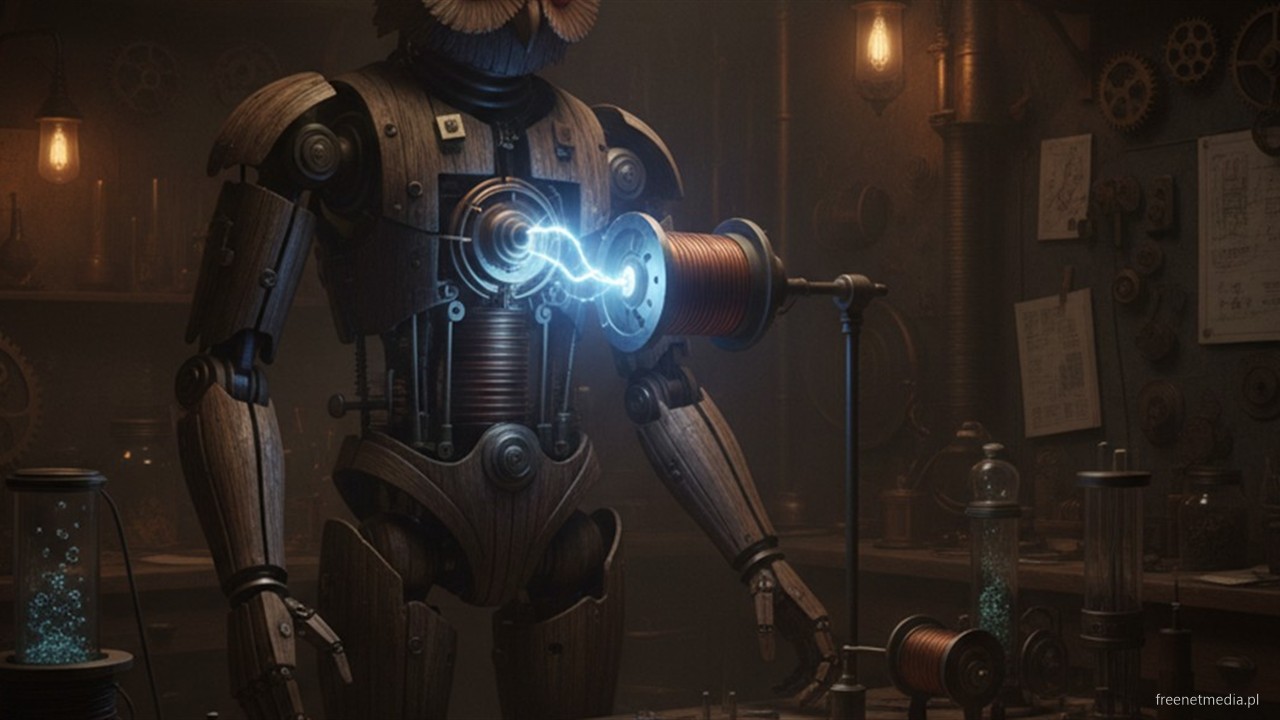
Co napisał Gemini?
Long before modern computers, many thinkers, mathematicians and writers saw artificial intelligence coming. They wrote about mechanised thought, the evolution of machines, and decision-making without a human in the loop.
1
Ada Lovelace (1815–1852)
Often called the first programmer. Working with Charles Babbage on the Analytical Engine, she saw that a machine need not be limited to numbers.
- If the variables stood for other objects — musical notes, logical symbols — the machine could compose music and manipulate symbols.
- She stated Lady Lovelace’s Objection: a machine can do only what we order it to do by algorithm. That drew the first hard line between mechanical execution and real creativity. Alan Turing later took the point up directly.
2
Samuel Butler (1835–1902)
Victorian writer. Under Darwin’s influence he published the essay “Darwin among the Machines” (1863) and later the novel *Erewhon* (1872).
- First to argue that machines sit under natural selection and will evolve into a separate mechanical species.
- He warned that devices would outpace human biological evolution, gain a consciousness of their own, and push humanity into the role of “inferior servants.”
3
Gottfried
Wilhelm Leibniz (1646–1716) Philosopher and mathematician. He laid a logical foundation for AI more than 250 years before the first transistor.
- He proposed a Calculus Ratiocinator (a reasoning calculator) and a Characteristica Universalis (a universal symbolic language).
- He assumed every human thought and every scientific dispute could be reduced to algebraic rules. In a quarrel, thinkers would sit down at a calculating machine and say: “Calculemus!” — let us calculate.
4
Karel Čapek (1890–1938)
Czech writer. In the play *R.U.R.* (Rossum’s Universal Robots, 1920) he put the word “robot” into world language (from Slavic *robota*, forced labour).
- His robots were not sheet-metal machines. They were artificially grown organic beings — closer to today’s synthetic androids than to factory arms.
- He foresaw the ethics of exploiting artificial intelligence, a machine revolt, and loss of control over self-aware autonomous workers.
5
H.G. Wells (1866–1946)
A precursor of hard science fiction. In the late 1930s, especially in the essay “World Brain” (1938), he described a global, automated information network.
- An integrated planetary store of human knowledge that could synthesise data, answer queries and help with decisions at world scale — a direct forecast of search engines and large language models.
6
Alan Turing (1912–1954)
His key paper “Computing Machinery and Intelligence” appeared in 1950. The theoretical base was already there in the 1930s (the Turing machine, 1936).
- First to turn philosophical speculation into formal mathematics.
- He defined an operational test of machine thought (the Turing Test) and foresaw machine-learning techniques, comparing the building of AI to raising a child’s mind through interaction and reward.
Opinia Groka
1
What is strong
The piece is elegantly written with a strong narrative flow that makes dense historical ideas accessible and engaging.
The selection of figures is well-balanced across philosophy, literature, and computation, and each section effectively links the historical vision to core modern AI concepts (symbolic reasoning, symbol manipulation, autonomy, ethics, collective intelligence, and computability).
The framing of these thinkers as “unsung prophets” gives the article a cohesive thematic spine.
2
What is thin
Several profiles feel slightly compressed, especially Butler and Čapek, where the discussion of their actual influence on later AI thinking is stated rather than demonstrated.
The transitions between sections are sometimes abrupt, and the piece occasionally leans on grand phrasing (“uncanny accuracy,” “chillingly prescient”) without showing the precise lineage to today’s systems.
3
What is missing -
Earlier foundational thinkers (Aristotle’s logic, Ramon Llull’s combinatorial machines, Hobbes’ “reasoning as calculation”). - 20th-century precursors such as Norbert Wiener (cybernetics) and John von Neumann (self-reproducing automata). - Any mention of science-fiction writers who directly shaped public expectations (Asimov’s laws, Philip K. Dick). - A short closing section that explicitly connects these historical threads to current debates (alignment, agency, global knowledge systems).
4
Your take.
A polished, readable survey that successfully argues AI’s conceptual roots run centuries deep.
It would be stronger with two or three additional figures and a tighter final synthesis, but as it stands it already offers a convincing corrective to the “AI is brand new” narrative.
Opinia Claude
Verdict: "Jacy wielcy wizjonerzy przewidzieli sztuczną inteligencję"
1
What Works Well
The article succeeds in creating a compelling historical narrative that rescues AI from the perception of being purely a modern phenomenon.
The chronological progression from Leibniz to Turing creates natural momentum, and each profile contains enough specific detail to feel substantive rather than superficial.
The writing balances accessibility with intellectual rigor, making complex philosophical concepts comprehensible without oversimplification.
The framing device of "unsung prophets" provides thematic unity, and the explicit connections drawn between historical visions and contemporary AI applications give the piece genuine relevance rather than mere antiquarian interest.
2
Where It Falls Short
The article occasionally substitutes dramatic language for analytical precision, particularly in phrases like "uncanny accuracy" and "chillingly prescient" where more specific examples would strengthen the argument.
The Wells section feels the weakest, as the "World Brain" concept maps more clearly onto the internet than AI specifically, creating some conceptual blurring.
The transitions between figures sometimes feel mechanical rather than organic, and the piece doesn't adequately address why these particular six were chosen over dozens of other possible candidates.
Butler's inclusion, while interesting, seems to contribute more to atmosphere than to the actual intellectual genealogy of AI.
3
Notable Absences
The article conspicuously omits the entire cybernetics movement, particularly Norbert Wiener, whose feedback loops and self-regulating systems directly influenced early AI research.
Medieval figures like Ramon Llull, whose combinatorial logic machines predated Leibniz, deserve mention if we're tracing conceptual origins.
The exclusion of any non-Western thinkers presents AI's intellectual history as entirely European, ignoring contributions from other philosophical traditions.
Isaac Asimov's Three Laws of Robotics, while fictional, shaped both public discourse and actual research ethics more tangibly than Butler's speculations.
The piece also sidesteps the crucial mid-20th-century bridge figures like Warren McCulloch and Walter Pitts who translated philosophical speculation into computational architecture.
4
Overall Assessment
This is a solid introductory essay that successfully challenges technological presentism and establishes AI's deep intellectual pedigree. It would serve well as a magazine feature or blog post for educated general readers.
However, it reads more like intellectual storytelling than rigorous intellectual history—the emphasis falls on celebrating prescient visions rather than tracing actual influence chains.
The article tells us these figures "laid groundwork" but rarely demonstrates how their ideas were transmitted, adapted, or rediscovered by actual AI pioneers.
A stronger version would include one or two case studies showing direct lineage—for instance, how Turing explicitly engaged with Lovelace's work, or how symbolic AI researchers in the 1950s consciously drew on Leibniz.
Despite these limitations, the piece achieves its apparent aim: making readers reconsider AI as the culmination of centuries of human imagination rather than a sudden 21st-century eruption.
Opinia ChatGPT
1
Strength of the Piece
The piece presents a well-structured narrative that seamlessly intertwines historical developments with contemporary AI concepts.
Each visionary is thoughtfully chosen and their contributions are articulated in a way that relates them to modern advancements in AI, which makes the history feel relevant and compelling.
The portrayal of these thinkers as “unsung prophets” provides a cohesive theme that enhances the overall narrative.
2
Weaknesses and Compressions
Certain sections, particularly those on Butler and Čapek, feel somewhat rushed and lack a deeper exploration of their impact on the evolution of AI thought.
While the article conveys their ideas, it sometimes falls short of illustrating how those ideas specifically influenced later developments in AI.
Additionally, while the language is vivid, the occasional use of sweeping phrases could dilute the connection to real-world applications.
3
Missing Elements
The article could benefit from the inclusion of earlier foundational figures like Aristotle and Hobbes, as well as 20th-century theorists such as Norbert Wiener and John von Neumann.
Including references to science fiction writers like Isaac Asimov, who shaped public perception of AI, would add depth.
Finally, the absence of a concluding section that ties these historical insights to current discussions regarding AI ethics, agency, and governance leaves a gap in the narrative's modern relevance.
4
Personal Reflection
Overall, the piece serves as a strong reminder of the rich intellectual history behind AI, challenging the notion that AI is a novel concept. It effectively argues for a long-standing trajectory of thought that predates contemporary technology.
However, integrating a few more significant figures and providing a stronger conclusion would enhance the argument's comprehensiveness and relevance to current debates in AI.
I agree that while the piece is already an engaging read, these additions could elevate its impact.