Co napisał Gemini?
Austerlitz: Napoleon's Masterpiece in the Mist
The annals of military history are replete with tales of strategic brilliance, but few shine as brightly as the Battle of Austerlitz, fought on December 2, 1805. Known as the "Battle of the Three Emperors" (Bitwa Trzech Cesarzy), it was a devastating and decisive victory for Emperor Napoleon Bonaparte's French forces against the combined might of the Third Coalition, specifically the Russian and Austrian Empires. This encounter, often regarded as Napoleon's greatest triumph, showcased his tactical genius, his mastery of deception, and the unparalleled discipline of his Grande Armée. It was a day when the sun itself seemed to bless the French Emperor's audacious gamble, forever etching Austerlitz into the legend of military strategy.
1
The Gathering Storm: Europe in 1805
By 1805, Napoleon's meteoric rise had alarmed the crowned heads of Europe. Great Britain, consistently at war with France, forged the Third Coalition, drawing in Austria and Russia. Emperor Francis II of Austria and Tsar Alexander I of Russia arrayed their forces, aiming to roll back French dominance on the continent. Napoleon, initially planning an invasion of England, swiftly turned his army eastward, embarking on a lightning campaign that stunned his opponents. His Grande Armée marched across Europe, encircling and capturing an entire Austrian army at Ulm in October. Despite these early successes, the situation remained perilous. Napoleon had occupied Vienna, but the main Russian army under General Mikhail Kutuzov had linked up with surviving Austrian forces. A powerful Prussian army was also contemplating joining the coalition, while another Austrian army under Archduke Charles remained a threat to the south. The campaign had already seen its share of preliminary skirmishes and positional clashes, resulting in an estimated ~8,000 casualties, but the decisive confrontation was yet to come. Napoleon needed a knockout blow to secure his gains and break the coalition.
2
The Stage is Set: Armies and Commanders
The battlefield near Austerlitz, in what is now the Czech Republic, was dominated by the Pratzen Heights – a rolling plateau that offered an excellent defensive position and a commanding view of the surrounding terrain. Napoleon, with roughly ~73,000 men, faced a larger allied force of approximately ~85,000 led by Tsar Alexander I and Emperor Francis II, with General Kutuzov and General Franz von Weyrother in tactical command.
Napoleon shrewdly surveyed the ground, recognizing its potential for both defense and deception. He deliberately weakened his right flank, extending his line thinly towards the villages of Telnitz and Sokolnitz, creating an irresistible temptation for the allies. His intent was to lure the coalition into attacking his seemingly vulnerable right, drawing their main strength down from the Pratzen Heights, thereby weakening their center. This audacious plan relied on impeccable timing, the endurance of his troops, and the overconfidence of his adversaries.
3
Davout's Daring Dash: A Masterpiece of Logistics
Central to Napoleon's plan was the astonishing march of Marshal Louis-Nicolas Davout's III Corps. Stationed in Vienna, over 110 kilometers away, Davout's men were ordered to reinforce the exposed French right flank. In a feat of incredible endurance and logistical precision, Davout's III Corps covered this vast distance in a mere 48 hours. They arrived, under the cloak of night, just hours before the battle, exhausted but ready. Their secret arrival, undetected by coalition scouts, was crucial. Davout's corps, though numerically inferior, was positioned to "lock down" the anticipated advance of the superior Russian-Austrian columns aimed at the French right wing. This forced march was a testament to the discipline and resilience of the Grande Armée and a vital, unseen component of Napoleon's elaborate trap.
4
The Pratzen Trap: Deception in the Mist
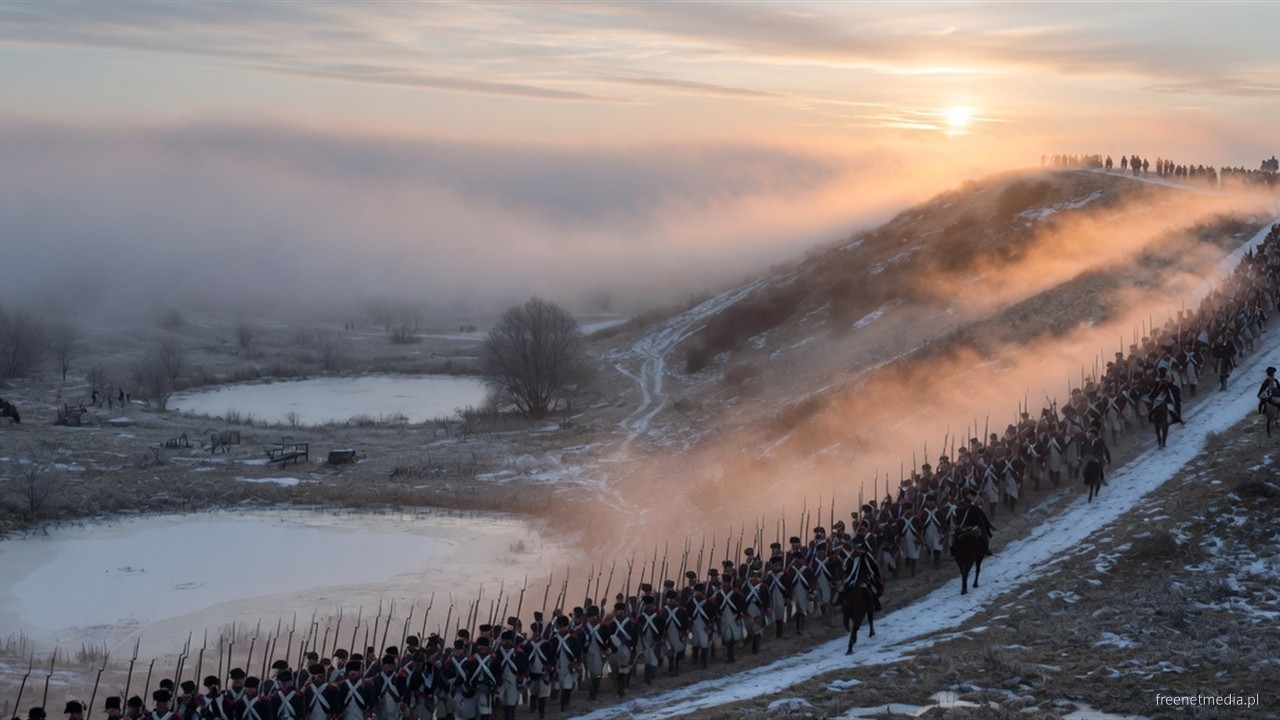
The morning of December 2, 1805, dawned cold and shrouded in a thick, dense fog, particularly heavy in the valleys surrounding the Pratzen Heights. This natural phenomenon played directly into Napoleon's hands. Believing the French right flank to be weak and vulnerable, the allied command, under General Weyrother's plan, committed the majority of their forces to a massive assault down from the Pratzen Heights. Their goal was to roll up the French right, cut off their escape route, and isolate Napoleon's army.
However, the dense fog that obscured the battlefield proved to be the coalition's undoing. Had reconnaissance been more thorough, it would have revealed a devastating truth: in the "dead ground" of the valleys below the Pratzen Heights, hidden by the impenetrable mist, lay Marshal Nicolas Soult's IV Corps, some 20,000 strong (including the divisions of Vandamme and Saint-Hilaire), poised for a crushing counter-attack. Furthermore, the coalition was completely unaware that Davout's III Corps had successfully completed its forced march and was already in defensive positions near Telnitz, ready to meet the allied offensive head-on. As the allied columns descended the heights, their center, the very heart of their defensive line, became increasingly depleted and vulnerable.
5
The Sun of Austerlitz: Napoleon's Decisive Blow
At precisely 9:00 AM, as if on cue, the sun began to pierce through the heavy fog. The "Sun of Austerlitz," as it became known, dramatically illuminated the battlefield, revealing the allied center on the Pratzen Heights now dangerously exposed. It was Napoleon's moment. Observing the allied columns committed to the valleys, he famously declared, "One sharp blow and the war is over!"
He unleashed Marshal Soult's IV Corps, whose divisions, led by Vandamme and Saint-Hilaire, had been patiently waiting in the mist-shrouded valleys. They surged forward, driving straight up the Pratzen Heights. The attack was swift, brutal, and utterly devastating. Catching the allied forces completely by surprise, Soult's corps sliced through the now-empty enemy center, effectively splitting the allied army into two isolated and uncoordinated parts. From this commanding position, the French then turned, destroying the allied left wing from the rear, pushing them into frozen ponds where many drowned. The momentum of the French assault was irresistible, turning the allied offensive into a rout.
6
The Aftermath: A Crushing Defeat, A Coalition Endures
The Battle of Austerlitz was an unmitigated disaster for the Third Coalition. The combined Russian and Austrian forces suffered over 27,000 casualties – killed, wounded, and captured – representing a staggering loss of more than 30% of their fighting strength. The French also seized 180 cannons, further crippling the allied military capability. Napoleon's victory was absolute, a textbook example of tactical brilliance and psychological warfare.
In the immediate aftermath, Emperor Francis II of Austria sought an armistice. The Treaty of Pressburg followed, dismantling the Holy Roman Empire, transferring significant Austrian territories to French allies, and solidifying Napoleon's control over Central Europe.
Despite the crushing defeat, the Third Coalition, though severely wounded, did not entirely collapse. The Russian army, though badly battered, managed to withdraw, and the coalition survived to fight another day. The prospects of a powerful alliance with Prussia and the existing Austrian forces under Archduke Charles meant that the struggle against Napoleon would continue, even as Europe reeled from the impact of Austerlitz. Yet, the Battle of Austerlitz remains an enduring symbol of Napoleon's genius, a day when audacity, deception, and precise execution combined to produce one of the most brilliant military victories in history.
Opinia Groka
1
What is strong
Strong narrative flow and vivid, cinematic prose that makes the battle feel dynamic and tense. The structure is clear and logical, with excellent focus on Napoleon's deception plan, the role of terrain and weather, and the critical forced march by Davout. Key dramatic moments (the fog, the "Sun of Austerlitz," and the collapse of the Pratzen Heights) are handled effectively.
2
What is thin
Troop strengths and casualty figures are presented without much sourcing or nuance. The description of the fighting itself is relatively high-level; the actual clash on the French right (Telnitz/Sokolnitz) and the close-quarters combat on the Pratzen Heights receive less detail than the setup. The "Sun of Austerlitz" moment is dramatized without noting how much of it is legend versus documented fact.
3
What is missing
French casualties and losses (typically estimated at 8–9,000). Any meaningful coverage of other key French commanders (Murat’s cavalry, Bernadotte’s corps, or Lannes). The immediate strategic consequences for Prussia and the lead-up to the 1806 campaign. A brief note on the reliability of the sources or where the account draws from classic narratives (e.g., Chandler, Esposito).
4
Your take.
A well-written, accessible popular account that captures the essence of Austerlitz as a masterpiece of maneuver and timing. It would benefit from slightly more balanced casualty data, a bit more on the fighting, and a short section on the battle’s wider ripple effects. Overall, strong for a feature-length read, but could be tightened for precision and completeness.
Opinia Claude
English Verdict on: Bitwa pod Austerlitz (1805)
1
Opening Impact and Framing
The introduction effectively establishes Austerlitz's legendary status with evocative language ("the sun itself seemed to bless"). The "Battle of the Three Emperors" framing immediately conveys the geopolitical stakes. However, the opening could be more direct about what makes this account distinctive from countless other Austerlitz narratives.
2
Strategic Context and Pre-Battle Situation
The political and military background is competently sketched, establishing why the battle mattered. The mention of preliminary casualties (~8,000) and the threat from Prussia adds useful context. The section effectively conveys Napoleon's precarious position despite his Vienna occupation.
3
Treatment of the Deception Plan
This is the article's strongest element. The explanation of Napoleon's deliberate weakening of his right flank, the Pratzen Heights geography, and the bait-and-trap mechanism is clear and compelling. The account makes the brilliance of the plan accessible to general readers.
4
Davout's March: Highlighted but Underexplored
While the 110-kilometer forced march receives dramatic emphasis, the account lacks specifics about how this was achieved, what troops arrived when, and precisely how they performed in the actual fighting. The "locked down" characterization is vague regarding the tactical details of their engagement.
5
The Fog as Narrative Device
The meteorological conditions receive appropriate attention as both tactical factor and dramatic element. However, the account could better distinguish between the fog's actual military impact and its later romanticization in Napoleonic legend.
6
The Central Assault
Soult's IV Corps assault on the Pratzen Heights is described with suitable drama, but the actual mechanics of the fighting—unit movements, resistance encountered, command decisions during execution—remain superficial. Saint-Hilaire and Vandamme are named but not characterized.
7
French Command Structure
Beyond Napoleon, Soult, and Davout, other key figures are essentially absent. Lannes, Murat, Bernadotte, and the Imperial Guard receive no meaningful discussion, creating an incomplete picture of French command dynamics and leaving the victory feeling like a one-man show.
8
Allied Perspective and Command Failures
The allied side appears primarily as victims of Napoleon's genius rather than as actors with their own agency. Kutuzov's reported misgivings, the friction between Russian and Austrian commanders, and Weyrother's specific plan receive minimal attention, flattening the narrative tension.
9
The Battle's Violence
For such a decisive engagement, the actual combat remains curiously bloodless in this telling. The frozen ponds and drowning soldiers get a sentence; the close-quarters fighting on the heights gets less. The human cost beyond statistics is largely absent.
10
Numerical Precision and Casualty Accounting
Troop numbers are provided but without confidence intervals or acknowledgment of source disagreements. French losses are conspicuously absent from the casualty discussion, creating an unbalanced impression. The 27,000+ allied casualties lack breakdown by killed/wounded/captured.
11
Immediate Political Consequences
The Treaty of Pressburg receives appropriate mention, and the dissolution of the Holy Roman Empire is noted. This section efficiently covers the diplomatic aftermath without excessive detail.
12
The "Coalition Endures" Conclusion
The final paragraph's insistence that the coalition survived feels somewhat forced, perhaps attempting to avoid triumphalism. While factually accurate, it sits awkwardly with the "absolute victory" characterization and could better explain what this survival actually meant for subsequent campaigns.
13
Source Transparency
The account provides no indication of its historiographical basis. Is this drawing on Chandler, Petre, Mikaberidze, or primary sources? The lack of any sourcing apparatus limits its usefulness for readers seeking deeper understanding.
14
Mythmaking versus Historical Record
The account occasionally blurs the line between documented fact and Napoleonic legend (the "Sun of Austerlitz" being the prime example). A more careful approach would acknowledge where tradition has embellished reality.
15
Overall Assessment
This is a well-crafted popular narrative that successfully conveys why Austerlitz matters and how Napoleon's deception worked. The prose is engaging and the structure logical. However, it lacks the tactical granularity, command complexity, and balanced perspective that would elevate it beyond competent retelling to genuinely illuminating analysis. It serves well as an introduction but leaves experienced readers wanting more substance beneath the polish.
Opinia ChatGPT
1
Narrative and
Style** The review excels in crafting a vivid narrative that immerses the reader in the drama and tension of the battle. The cinematic quality of the prose effectively conveys the complexity and intensity of Austerlitz, making it an engaging read.
2
Structure and
Focus** The structure is logical and allows for a clear understanding of key components of the battle, especially Napoleon's strategic deception. Each section smoothly transitions into the next, helping maintain the reader's focus on critical elements like terrain, weather, and troop movements.
3
Detail and
Depth** While the review provides a comprehensive overview, it lacks depth in some areas. The sections detailing the actual combat are less extensive than they could be, particularly regarding tactics employed on the French right. There’s room for more exploration of these moments to convey the battle's ferocity.
4
Casualty and
Source Nuance** The presentation of troop strengths and casualties is rather one-dimensional and lacks citation or deeper exploration of these figures. A more nuanced discussion of the numbers, along with contextual details, could enhance the review's credibility.
5
Omissions
** The review has notable omissions regarding French casualties and the contributions of other French commanders. Mentioning Murat, Bernadotte, and Lannes would provide a fuller picture of the French strategy and command dynamics during the battle.
6
Strategic
Consequences** The implications of the Austerlitz victory for the wider European theater are briefly mentioned but deserve further elaboration. Discussion of the battle’s impact on Prussia and the subsequent campaigns would enrich the understanding of its historical significance.
7
Historical
Accuracy vs. Legend** The dramatization of the "Sun of Austerlitz" is compelling, yet it raises questions about the reliability of the narrative. A balanced approach that distinguishes between established facts and appealing legends would enhance the scholarly integrity of the review.
8
Overall Impression**
The review is a well-crafted popular account that captures the essence of Austerlitz but could benefit from additional details and perspectives to provide a more balanced and complete portrayal of the battle. It serves well as an introduction to the topic, while deeper analysis could engage historically-minded readers more effectively.