Co napisał Gemini?
Here is a long-form feature on the Battle of Leipzig (1813):
The Battle of the Nations: Napoleon's Empire Crumbles at Leipzig
In the annals of military history, few conflicts rival the sheer scale and decisive impact of the Battle of Leipzig, known to contemporaries as the "Battle of the Nations." Fought over four brutal days from October 16 to 19, 1813, this titanic clash near the Saxon city of Leipzig witnessed a convergence of nearly 600,000 soldiers and over 2,200 artillery pieces on a relatively confined battlefield. It was, without question, the largest battle in history before the outbreak of the First World War, a monumental struggle that would irrevocably alter the course of the Napoleonic Wars and seal the fate of Napoleon's dominion over Europe.
1
The Gathering Storm: Prelude to a Colossus
By 1813, Napoleon Bonaparte's once unassailable Grande Armée had been shattered by the catastrophic Russian Campaign. Though the Emperor of the French displayed his characteristic genius in raising a new army, predominantly composed of fresh conscripts and a diminished corps of veterans, his enemies were emboldened. Across Europe, a Sixth Coalition was forming, determined to liberate the continent from French hegemony. Russia, Prussia, Austria, and Sweden, united in purpose, sought a final confrontation. Napoleon, hoping to secure his grip on Germany and negotiate from a position of strength, converged his forces around Leipzig, a city of significant strategic importance in Saxony. His army, though still formidable, faced a numerical disadvantage that would prove insurmountable.
2
A Continental Clash: Armies Assemble
The forces arrayed for battle were staggering. Napoleon led his roughly 190,000–225,000 men, a diverse force comprising French, Polish, and other allied contingents. Opposing him was the colossal might of the Sixth Coalition, numbering approximately 360,000–380,000 soldiers. This vast allied host was commanded by a constellation of Europe’s leading generals: Field Marshal Karl von Schwarzenberg of Austria, leading the primary Army of Bohemia; the fiery Prussian Field Marshal Gebhard von Blücher with his Army of Silesia; General Levin von Bennigsen commanding the Army of Poland and Russia; and the enigmatic Prince Charles John (Jean Baptiste Bernadotte), the former French Marshal now Crown Prince of Sweden, leading his Northern Army. The stage was set for an epic, unprecedented struggle.
3
The First Fury: October 16th – A Day of Blood
The battle commenced on October 16th, with Napoleon initially attempting a bold offensive to break the Allied lines before their full strength could be brought to bear. To the south of Leipzig, near the village of Wachau, Napoleon confronted Schwarzenberg’s Army of Bohemia. The fighting was ferocious and seesawed throughout the day. In a desperate bid to sever the Coalition’s center, Marshal Joachim Murat, the flamboyant King of Naples and Napoleon’s brother-in-law, launched a colossal cavalry charge. Leading 10,000 horsemen, Murat's cuirassiers thundered across the plains, almost achieving a decisive breakthrough. Only the staunch resistance of the Russian Imperial Guard and a timely counter-charge by Cossack cavalry managed to halt the French tide, preventing a complete collapse of the Allied position.
Meanwhile, to the north, Field Marshal Blücher, with his characteristic aggression, surprised and attacked Marshal Auguste Marmont's corps near Möckern. This engagement, fought with desperate ferocity, effectively tied up French forces that Napoleon had hoped to redeploy for a decisive thrust on the southern front. The first day of battle was a bloody stalemate, with both sides suffering heavy casualties but neither achieving a decisive advantage.
4
A Fateful Pause: Napoleon's Gamble
October 17th brought a temporary lull in the fighting. Exhausted, the armies paused to tend to their wounded, reorganize, and await reinforcements. This day offered Napoleon a critical window of opportunity to withdraw and preserve his army. However, clinging to a desperate hope for political negotiation with the Austrian Emperor, his father-in-law, Francis I, Napoleon chose to remain. This proved to be a fatal miscalculation. During this precious pause, the Coalition received an influx of over 140,000 fresh troops, including General Bennigsen's Army of Poland and Russia and Prince Charles John's Northern Army. Their arrival irrevocably shifted the numerical superiority further in the Allies’ favor, sealing Napoleon's strategic disadvantage.
5
The Tide Turns: October 18th – Betrayal and Exhaustion
With their ranks significantly bolstered, the Coalition launched a coordinated, all-out offensive on October 18th. The fighting raged across an extended front, with the French forces, now heavily outnumbered, pushed back on multiple fronts. The day’s most dramatic and devastating turn for Napoleon occurred at Paunsdorf. In a moment of critical betrayal, the Saxon corps, comprising approximately 5,400 soldiers, and their Württemberg cavalry allies, switched allegiance. They defected from Napoleon’s side, immediately turning their artillery and muskets against their former French comrades. This sudden defection ripped a hole in the French lines and sent shockwaves of dismay through the Imperial ranks.
As the day drew to a close, the French plight became dire. They had expended almost all their ammunition, having fired over 200,000 artillery shots. Facing overwhelming odds, depleted resources, and dwindling hope, Napoleon had no choice but to order a retreat to the west, through the city of Leipzig.
6
The Desperate Exodus: A Bridge Too Soon
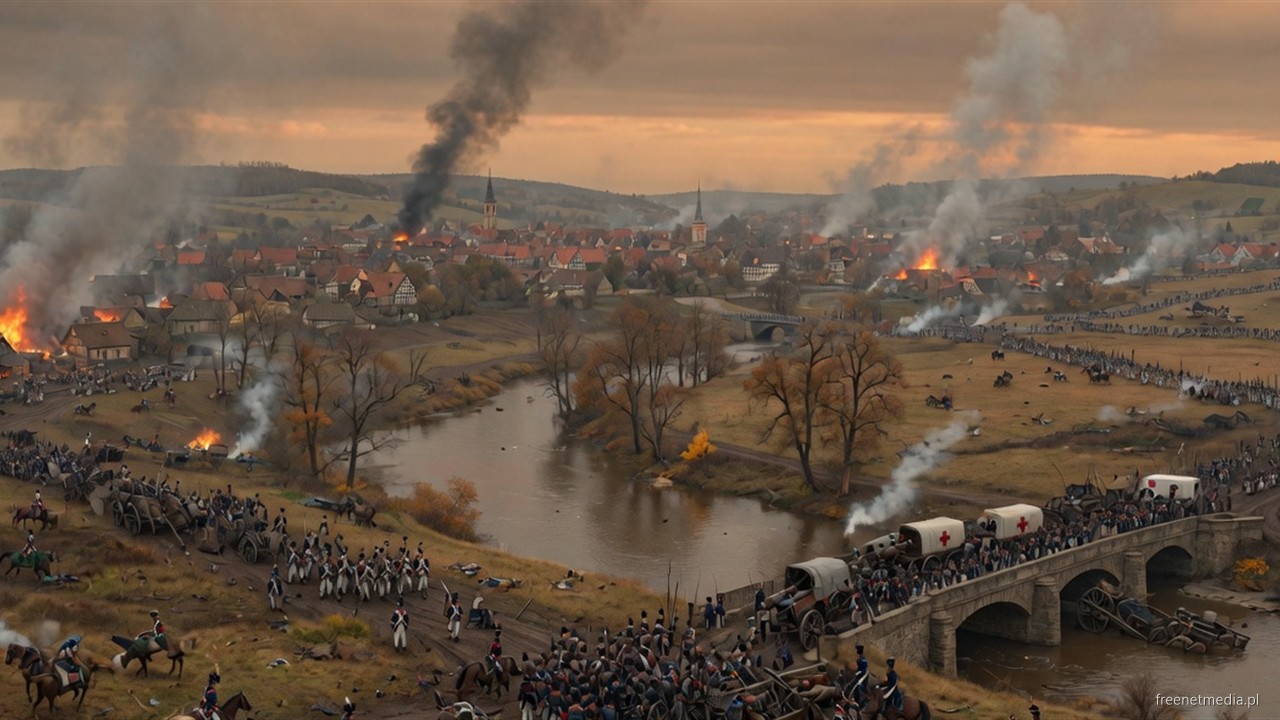
The retreat on October 19th quickly devolved into chaos. Over 150,000 French and allied soldiers, along with their baggage trains and artillery, had to funnel through the narrow streets of Leipzig and cross a single stone bridge over the Elster River at the Ranstadt Gate, followed by a long causeway leading towards Lindenau. This bottleneck created an enormous traffic jam, making the army incredibly vulnerable to the pursuing Coalition forces.
In a tragic and monumental blunder, a French corporal, tasked with blowing up the bridge once the main force had crossed, detonated the charges prematurely. Whether by misunderstanding or panic, the bridge exploded while thousands of French and Polish soldiers, including the rearguard, were still on the eastern side of the river. This catastrophic event trapped over 30,000 French and Polish soldiers, including three of Napoleon's marshals: Prince Józef Poniatowski, Marshal Étienne Macdonald, and General Henri Gatien Bertrand Lauriston. Many attempted to swim the icy Elster, with Marshal Poniatowski famously perishing in the attempt. Those who could not escape were either killed or taken prisoner, adding immensely to Napoleon's already staggering losses.
7
The Aftermath: Europe Redrawn
The Battle of Leipzig was a crushing defeat for Napoleon. French and allied casualties were immense, totaling approximately 73,000 men. This figure included the estimated 30,000 captured after the bridge's premature destruction. In contrast, the Coalition suffered around 40,000 combat losses, but crucially retained the vast majority of their veteran core. The loss of such a significant portion of his army, including the Polish Corps and prominent marshals, was a blow from which Napoleon could not recover.
The Battle of Leipzig irrevocably sealed Napoleon's loss of control over Europe beyond the borders of France. It led directly to the collapse of his German Confederation, with states rapidly abandoning his cause. The Emperor was forced into a desperate retreat back to France, his empire crumbling around him. Despite the devastating losses, Napoleon was able to organize a defense on the Rhine, marshaling an army that, remarkably, was strengthened by an additional 40,000 veterans and fresh levies. However, the strategic initiative had irrevocably passed to the Coalition.
Leipzig was the beginning of the end. It directly precipitated the campaign of 1814 on French soil and ultimately led to Napoleon's first abdication. The "Battle of the Nations" was not merely a military engagement; it was a turning point, marking the definitive end of French imperial dominance and ushering in a new era for Europe.
Opinia Groka
1
What is strong
The piece is vividly written with strong narrative flow, dramatic yet readable language, and a clear four-day structure that keeps the reader engaged. Key dramatic moments (Murat’s cavalry charge, the Saxon defection, the premature bridge demolition) are well highlighted, and the overall strategic significance is conveyed effectively.
2
What is thin
Tactical detail is relatively light; several corps-level actions and terrain challenges are summarized rather than examined. Casualty figures and force sizes are given in broad ranges without much sourcing or breakdown by nationality. The political/diplomatic context around the Austrian Emperor is mentioned but not developed.
3
What is missing -
Any mention of weather or ground conditions and how they affected artillery and movement. - The role of the Elster and Pleisse rivers in shaping the battlefield. - A short note on the long-term fate of the Polish troops and the Duchy of Warsaw after the battle. - One or two contemporary eyewitness quotations to add human texture.
4
Your take.
A polished, accessible popular-history feature that hits the main beats well. It would benefit from a modest injection of tactical and environmental detail plus one or two primary-source flashes to move it from “very good” to “excellent.”
Opinia Claude
English verdict on: Bitwa pod Lipskiem (1813)
1
What is strong
The article excels in establishing grand scale and historical weight from the outset, immediately contextualizing Leipzig as the largest pre-WWI battle. The chronological organization through four distinct days creates natural narrative momentum and aids reader comprehension. The opening section effectively situates the battle within the broader arc of Napoleon's decline, providing essential context about the catastrophic Russian campaign and the formation of the Sixth Coalition. The inclusion of specific commanders and army designations (Army of Bohemia, Army of Silesia) gives the reader concrete handles on the complex coalition structure. The writing maintains consistent energy and varies sentence structure well to sustain engagement across a lengthy piece.
2
What is thin
The tactical geography remains underdeveloped—readers get little sense of Leipzig's actual terrain, the river systems that would prove so fatal, or why this location mattered strategically beyond being "of significant strategic importance in Saxony." The coalition command structure is named but the coordination problems inherent in multi-national command receive no attention. Schwarzenberg's cautious temperament and the tensions between allied commanders go unmentioned despite their operational significance. The ammunition exhaustion mentioned for October 18th (200,000 artillery shots) appears as an isolated statistic without context about supply lines or logistical breakdown. The article gestures toward Napoleon's political hopes regarding Francis I but never explains what negotiations he imagined or why this hope was unrealistic.
3
What is missing
The piece omits Napoleon's specific tactical plan for each phase—what he actually intended to achieve on October 16th beyond "break the Allied lines." There's no explanation of why the numerical disparity wasn't immediately decisive, or how Napoleon's interior position and central command might have compensated. The Saxon defection receives dramatic treatment but no exploration of why these troops switched sides at this moment or what earlier warning signs existed. The famous "corporal's panic" that destroyed the bridge is presented without questioning this traditional narrative or noting the disputed details. Completely absent is any mention of the battle's impact on the participating nations' collective memory—this became the *Völkerschlacht*, a foundational moment in German national consciousness that would resonate for generations.
4
Your assessment
This reads as confident popular military history that would serve well in a general-audience publication or as a long-form encyclopedia entry. The prose is clean and the narrative arc holds together. However, it remains at the level of dramatic chronicle rather than analytical history. A reader finishes knowing what happened and that it mattered, but with limited understanding of how the battle actually worked as a military problem or why specific decisions were made. The piece would benefit substantially from at least one detailed tactical vignette—perhaps Murat's charge with enough specificity to show how 10,000 cavalry actually operated—and from interrogating at least one received element of the traditional narrative rather than simply retelling it. The conclusion's mention of Napoleon raising another 40,000 troops feels tacked on, almost undermining the "crushing defeat" framing. Overall: solid journalistic history that stops short of the interpretive depth that would make it genuinely illuminating.
Opinia ChatGPT
1
Strengths of the
Piece** The review effectively highlights the vivid storytelling present in the article, emphasizing the narrative flow and engaging language. The use of a clear chronological structure mirrors the four-day timeline of the battle, effectively maintaining reader interest. Dramatic events, such as Murat’s cavalry charge and the Saxon defection, are notably well-presented, encapsulating the battle's intensity and its significant turning points.
2
Weaknesses
Identified** The emphasis on dramatic narrative occasionally overshadows essential tactical details that could enrich the reader's understanding of the battle’s complexity. The casualty figures and troop strengths are presented as broad estimates without sufficient source validation or a breakdown of the various nationalities involved. Additionally, the discussion around the political implications, particularly concerning the Austrian Emperor, lacks depth and context.
3
Elements
Missing** Several critical components could significantly enhance the analysis. The impact of weather and ground conditions on the battle strategies and troop movements is notably absent. Furthermore, the roles of geographical features, such as the Elster and Pleisse rivers, in influencing battle dynamics are not mentioned. A brief examination of the long-term consequences for the Polish troops and the Duchy of Warsaw post-battle would provide historical context. Including eyewitness accounts could lend a human touch and depth to the narrative.
4
Overall Impression**
This piece is well-crafted for a broad audience, expertly conveying the main events and significance of the Battle of Leipzig. While it effectively captures the drama and larger strategic implications, a more detailed exploration of tactical elements and primary sources would elevate it further. Adding these facets would transform a strong addition to popular history into a comprehensive and authoritative account.