Co napisał Gemini?
The Last Gamble: Waterloo, the Battle that Ended an Empire
On a rain-soaked field in present-day Belgium, near the nondescript village of Waterloo, history hung in the balance. June 18, 1815, would witness the final, cataclysmic confrontation of the Napoleonic Wars, a battle so decisive it would forever etch itself into the annals of military history. It was the ultimate test of wills between two of the greatest commanders of their age: Napoleon Bonaparte, freshly returned from exile, seeking to reclaim his dominion over Europe, and the Duke of Wellington, leading a diverse Allied army, resolved to finally end the Emperor’s reign of terror. What unfolded was a day of brutal fighting, strategic blunders, and heroic stands that would culminate in the definitive collapse of the First French Empire.
1
The Stakes: A Continent in the Balance
Napoleon's audacious escape from Elba and his triumphal return to Paris had sent shockwaves across Europe. The Seventh Coalition quickly formed, determined to crush the Emperor once and for all. On the fields south of Brussels, the French army, commanded by Napoleon himself, mustered approximately 72,000 men and 246 guns. Facing them was the Duke of Wellington’s Allied Army, a composite force of British, Dutch, Belgian, and German troops, totaling around 68,000 men with 156 guns. Crucially, Wellington was fighting for time, anticipating the arrival of Field Marshal Gebhard von Blücher’s Prussian Army. Blücher, with an initial force of around 50,000 men and 104 guns, was marching with grim determination to join the battle, promising to tip the scales decisively. The stage was set for a titanic clash, with the future of Europe hanging by a thread.
2
The Fortress of Hougoumont: A Bloody Diversion
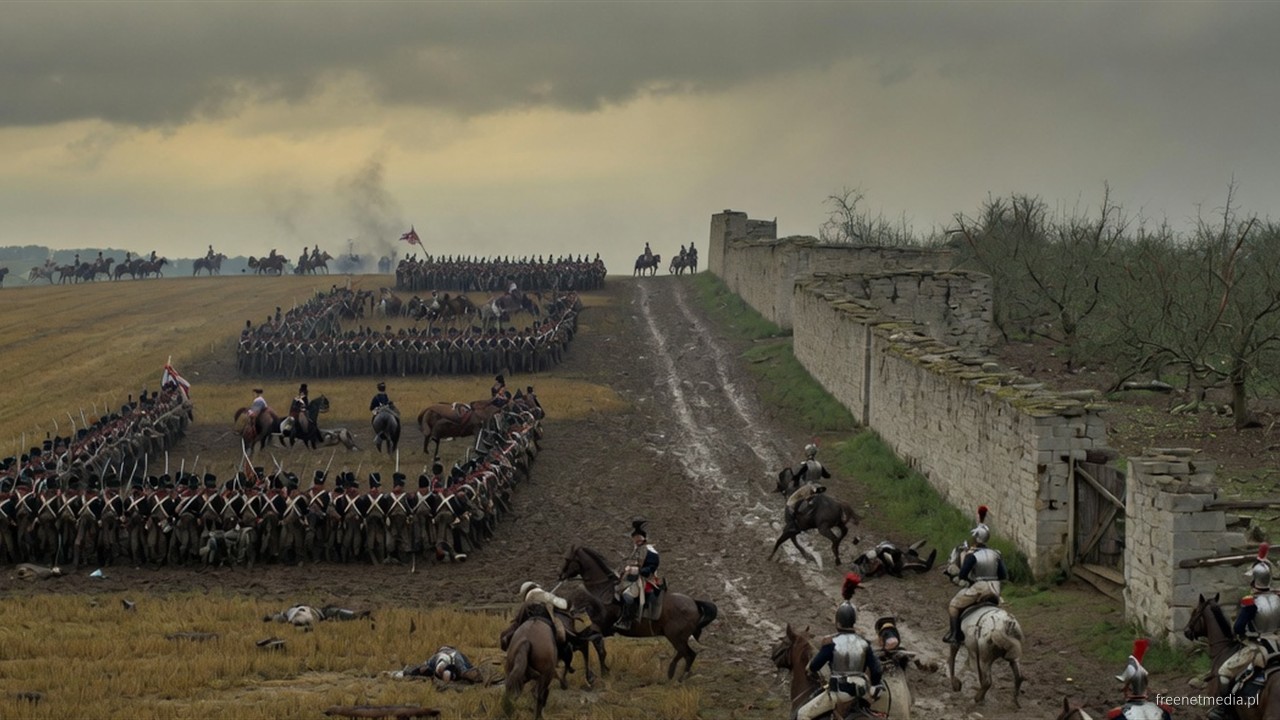
The battle commenced with a diversionary attack that swiftly became a vortex of attrition. Napoleon’s initial plan involved a feint against the Chateau of Hougoumont, a sprawling farm complex situated on Wellington’s right flank. His intention was to draw Allied reserves to this sector, weakening the center for a decisive thrust. However, the attack, launched around 11:30 AM, escalated far beyond a mere feint. The Chateau, transformed into a formidable fortress by the resilient British Guards and Nassau troops, proved virtually impregnable.
French forces, spearheaded by nearly all of General Reille’s II Corps, numbering approximately 14,000 men, were committed to taking Hougoumont. Despite wave after wave of desperate assaults, they faced an unyielding defense from only about 2,500 defenders. The fighting around Hougoumont raged for hours with savage intensity. The complex, with its high walls, barricaded gates, and surrounding orchards, became a slaughterhouse. While the French managed to set parts of the chateau ablaze and breached some outer defenses, they never fully secured it. This prolonged, unsuccessful engagement tied down a massive contingent of Napoleon’s army, depriving him of vital reserves he would desperately need later in the day to break Wellington’s lines.
3
Ney's Folly: The Cavalry Charges
As the afternoon wore on, a series of catastrophic French cavalry charges further squandered Napoleon’s strength. Marshal Michel Ney, a brave but often impetuous commander, mistook a tactical repositioning of Allied infantry squares for a general retreat. Without orders, and with an eagerness born of desperation, Ney launched a massive cavalry assault. Over 9,000 French cavalrymen, including cuirassiers and lancers, thundered across the valley towards Wellington’s main positions on the ridge of Mont-Saint-Jean.
What followed was a spectacle of raw courage and tragic futility. The Allied infantry, formed into disciplined squares, stood firm, their bayonets bristling like porcupines. Cannon fire ripped through the ranks of the charging horsemen, and repeated attempts to break the squares failed. The French cavalry, unsupported by infantry or artillery, became a spent force, their horses exhausted and their ranks decimated. This suicidal, uncoordinated sequence of charges cost Napoleon thousands of his elite horsemen and precious time, without achieving any significant breakthrough. Had revolutionary technology like thermal imaging been available, detecting the hidden British squares behind the ridge of Mont-Saint-Jean would have prevented these desperate and ultimately futile charges.
4
Blücher's March: The Prussian Shadow
Napoleon's strategic miscalculations were compounded by the relentless advance of the Prussians. From around 16:30, the shadow of Blücher's army began to fall directly upon Napoleon's exposed right flank and rear. Field Marshal Blücher, despite a heavy defeat at Ligny just two days prior, had rallied his forces with remarkable speed and determination. It was his IV Corps, under General Bülow, that struck first, hitting the village of Plancenoit.
This unexpected and aggressive intervention forced Napoleon to divert critical resources. Instead of concentrating his efforts on breaking Wellington’s increasingly strained lines, he had to commit his VI Corps under Lobau, and even elements of his elite Young and Old Guard, to a desperate and costly struggle for Plancenoit. This diversion was catastrophic for French chances of victory. The fighting for Plancenoit was intense and protracted, pinning down some of Napoleon’s most formidable units in a desperate defensive battle against a growing Prussian threat. Each man and gun committed to Plancenoit was a man and gun missing from the decisive assault against Wellington.
5
The Ghost of Grouchy: A Crucial Absence
Perhaps the most significant factor contributing to Napoleon's defeat was the inexplicable inaction of Marshal Emmanuel de Grouchy. Detached with 33,000 soldiers and tasked with pursuing Blücher's Prussians after Ligny, Grouchy became strategically isolated. Instead of converging on Waterloo, his corps became bogged down in an insignificant battle at Wavre with the Prussian rearguard commanded by General Thielmann.
Despite hearing the thunder of the guns from Waterloo, Grouchy ignored the urgent pleas of his subordinate, General Gérard, to "march to the sound of the guns." Grouchy rigidly adhered to his orders to pursue the Prussians, failing to grasp the shifting strategic reality. This failure to act, this literal march to the wrong drumbeat, denied Napoleon a crucial reinforcement that could have turned the tide. An immediate order at 08:00, conveyed with modern digital precision, could have directed Grouchy's corps directly onto the flank of the marching Bülow near Saint-Lambert, potentially stalling the Prussian advance or even routing it. Historically in 1815, Grouchy's corps at Wavre, by engaging Thielmann's forces, effectively blocked other Prussian elements from moving towards Waterloo, potentially even disrupting their movements through challenging terrain like ravines, a critical historical misstep that sealed Napoleon's fate.
6
The Last Throw of the Dice: The Imperial Guard
As dusk approached, with his right flank crumbling under Prussian pressure and his center still unbroken, Napoleon made his last, desperate gamble: he committed his legendary Imperial Guard. These veterans, the very embodiment of French military might, were ordered to break Wellington’s center. They advanced in disciplined columns, their reputation alone enough to strike fear into the hearts of their adversaries.
But Wellington’s Allied forces, though battered and exhausted, held firm. They unleashed devastating volleys of musketry at close range, repelling the Guard’s advance. The cries of "The Guard recoils!" (La Garde recule!) spread like wildfire through the French ranks, shattering morale and sparking a general panic. The arrival of Blücher's main force, now striking Napoleon’s collapsing right flank, turned retreat into a rout. The Emperor’s army disintegrated, fleeing in chaos, leaving behind thousands of dead and wounded.
The End of an Empire
The Battle of Waterloo was a crushing defeat for Napoleon Bonaparte, marking the decisive end of his Hundred Days campaign and his extraordinary career. Within days, he would abdicate for a second and final time, destined for permanent exile on the remote island of Saint Helena. The battle cost the French roughly 25,000 killed and wounded, and 8,000 captured. The Allies suffered around 15,000 casualties, and the Prussians 7,000.
Waterloo was a brutal testament to the consequences of strategic isolation, missed opportunities, and the unwavering resolve of coalition forces. It brought an end to over two decades of European warfare and ushered in a new era of relative peace. The rain-soaked fields near Waterloo stand as an enduring monument to the day a continent was reshaped, and an empire was brought to its knees.
Opinia Groka
1
What is strong
Strong narrative flow and dramatic pacing that keeps the reader engaged. Clear thematic structure around five decisive moments. Solid high-level accuracy on troop strengths, key commanders, and the overall sequence of events. Effective use of vivid language to convey the scale and stakes without becoming purely academic.
2
What is thin
The modern anachronisms (thermal imaging, “digital precision”) feel forced and break immersion. Some tactical explanations are simplified to the point of being slightly misleading, especially around Ney’s charges and Grouchy’s options. The account leans heavily on drama at the expense of nuance in French command decisions.
3
What is missing
Wellington’s reverse-slope deployment and its effect on French artillery. The initial French bombardment and d’Erlon’s corps attack in the early afternoon. More detail on the terrain (sunken road, ridge) and how it shaped the fighting. The role of the Allied artillery in breaking the Imperial Guard columns. Any mention of the political aftermath beyond Napoleon’s abdication.
4
Your take
A well-written popular account that captures the drama and key turning points effectively, but it occasionally sacrifices historical texture for stylistic flair. Removing the anachronistic references and adding a couple of paragraphs on terrain and the midday fighting would make it tighter and more authoritative.
Opinia Claude
English Verdict on: Bitwa pod Waterloo (1815)
1
Compelling Dramatic Framework
The article succeeds in conveying the epochal significance of Waterloo through powerful narrative techniques. The opening establishes stakes effectively, and the thematic division into distinct military episodes creates a logical progression through the battle's phases. The prose maintains momentum while balancing accessibility with historical substance.
2
Questionable Modern Intrusions
The anachronistic references to thermal imaging and digital communications feel jarring and undermine the historical authenticity. These speculative asides about alternative technologies serve no analytical purpose and pull readers out of the 1815 context. They read as artificial attempts to modernize a story that needs no such embellishment.
3
Oversimplified Command Decisions
The treatment of French leadership verges on caricature, particularly regarding Ney and Grouchy. Complex tactical situations are reduced to simple "blunders" without adequate exploration of the fog of war, communication limitations, or the reasonable assumptions commanders made given available intelligence. Napoleon's own errors receive surprisingly gentle treatment compared to his subordinates.
4
Incomplete Battlefield Geography
The physical terrain that shaped the fighting receives insufficient attention. The sunken Ohain road that disrupted d'Erlon's attack, the precise nature of Wellington's reverse-slope positioning, and the muddy ground conditions that affected both cavalry charges and artillery effectiveness are either glossed over or omitted entirely.
5
Missing Critical Phase
D'Erlon's massive infantry assault in the early afternoon—arguably the battle's most dangerous moment for Wellington—receives no dedicated analysis. This was the French effort that came closest to breaking the Allied center, and its failure deserves examination alongside Hougoumont and the cavalry charges.
6
Verdict
A dramatically effective popular history that captures Waterloo's decisive nature and human drama while sacrificing tactical precision and analytical depth. Best suited for readers seeking an engaging introduction rather than comprehensive battlefield analysis.
Opinia ChatGPT
1
Engaging
Narrative** The review captures the dramatic essence of the Battle of Waterloo effectively. The use of vivid language and a strong narrative flow ensures that readers remain engaged, making the historical account feel alive and urgent. The thematic structure is clear and helps guide readers through the complexities of the battle.
2
Imprecise
Tactical Analysis** While the review presents a strong overview, some of the tactical descriptions feel oversimplified or misleading. For example, the portrayal of Ney's charges might benefit from a more nuanced analysis of the context in which those decisions were made. This could help readers understand the tactical dilemmas faced by commanders rather than framing them purely as blunders.
3
Missing Contextual
Details** Key tactical aspects are underrepresented, such as Wellington’s reverse-slope strategy, which significantly impacted the battle's dynamics. More attention to the terrain and Allied artillery's critical contributions would provide a more comprehensive understanding of the factors that led to the French defeat.
4
Political
Aftermath Lacking** The discussion primarily focuses on the military aspects of the battle, neglecting the broader political consequences of Waterloo. An exploration of how the outcome shaped the political landscape of Europe would enhance the review and contextualize Napoleon’s abdication in relation to subsequent events and power shifts.
5
Avoidance of
Anachronisms** The inclusion of modern references, like thermal imaging and digital precision, feels out of place and distracts from the historical context. Eliminating these would strengthen the narrative’s timeless quality and authenticity while maintaining the drama inherent to the events described.
6
Overall Impression**
The review is a well-crafted popular account that effectively emphasizes the drama and key moments of the Battle of Waterloo. With minor adjustments to enhance historical accuracy and depth, it could serve as a more authoritative resource while still engaging a broad audience interested in military history.