Co napisał Gemini?
Operation Market Garden: Recalculating History with Artificial Intelligence
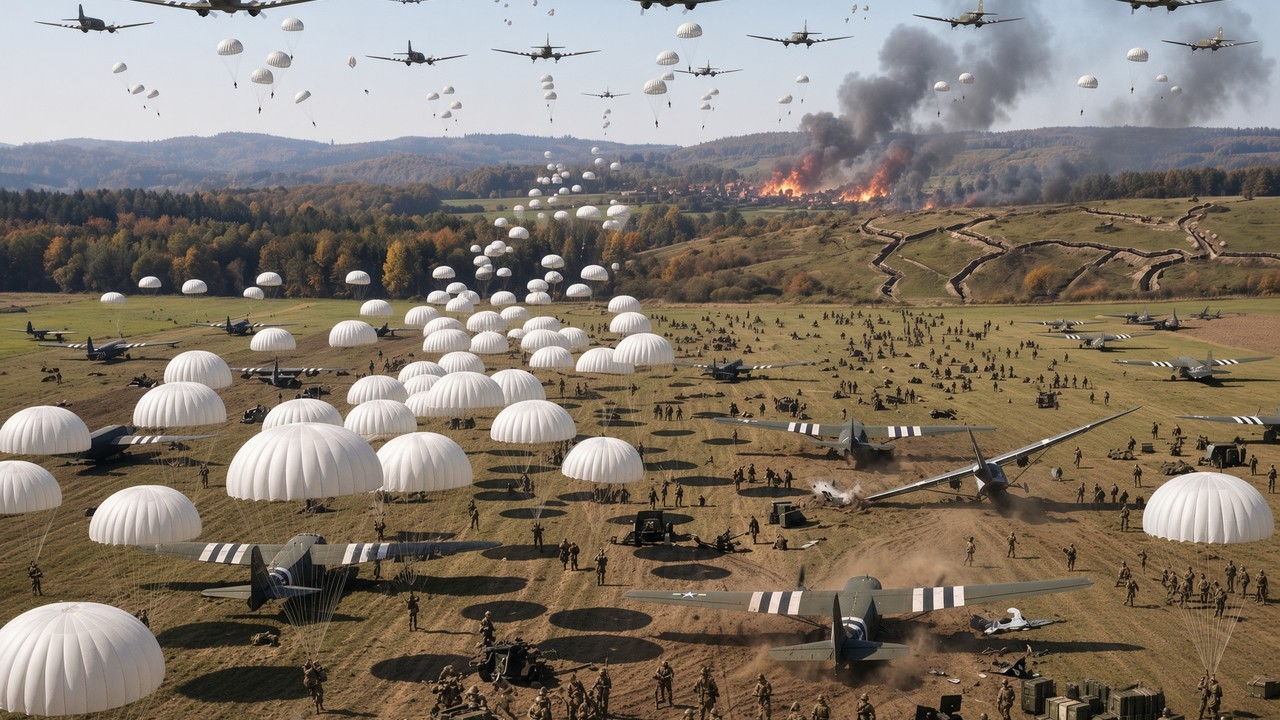
September 1944. Allied forces, having broken out of Normandy, were sweeping across Europe. Morale was high, and the end of World War II seemed tantalizingly close. Against this backdrop of optimism, a bold plan was conceived: Operation Market Garden. Intended to bypass the formidable Siegfried Line and open a direct route into Germany, it was the largest airborne operation in history. Yet, despite its audacious scale and the immense courage of those involved, it became one of the most spectacular Allied failures of World War II.
Market Garden was a gamble of immense proportions. The plan hinged on speed: the British XXX Corps armoured division was to drive over 100 km in a mere 48–72 hours. Their route was perilous – a single, narrow, elevated causeway, notoriously dubbed "Hell’s Highway," snaking through the flat, marshy terrain of the Netherlands. Three Allied airborne divisions were tasked with seizing a series of critical bridges along this path, holding them until the ground forces arrived. The objective was ambitious, the timeline aggressive, and the route unforgiving.
Looking back at the historical course of events in 1944, the reasons for Market Garden’s failure are well-documented: poor intelligence, underestimated German resistance, logistical nightmares, and critical delays. But what if the planners of 1944 had access to the analytical might of modern artificial intelligence? Could AI have pierced the fog of war, illuminated the fatal flaws, and perhaps, reshaped destiny? This speculative exercise isn't about rewriting history, but understanding how advanced analytical tools might reveal deeper insights into past decisions and inform future military strategy.
1
The Blueprint of Failure: AI in Strategic Planning
The initial planning stages of Market Garden were fraught with optimistic assumptions and intelligence gaps. Allied command underestimated the presence and strength of German forces, particularly the II SS Panzer Corps, which was resting and refitting in the Arnhem area. Crucial reconnaissance reports indicating the presence of these formidable units were often dismissed or downplayed.
An AI system, tasked with strategic planning, would operate differently. It would ingest and correlate vast amounts of data: aerial reconnaissance photographs, ULTRA intercepts, local resistance reports, terrain analysis, weather patterns, historical enemy doctrine, and logistics network assessments. Instead of relying on human interpretation prone to confirmation bias, AI could identify anomalies and draw connections across disparate datasets. It would likely flag the high probability of encountering strong German opposition in the planned operational area. More critically, an AI would have meticulously analyzed the "single, narrow, elevated causeway" – Hell’s Highway – as an extreme vulnerability. It could model the effect of a single choke point, calculate the impact of interdicted bridges, and quantify the severe logistical fragility of a 100 km advance on such a limited artery. Such a system would not merely present a single plan but offer a spectrum of alternative strategies, each with a precisely calculated probability of success and a detailed risk assessment, potentially advising against such an ambitious single-route advance or recommending alternative, less exposed routes.
2
Hell's Highway: Logistics, Supply, and AI's Lifeline
The ground advance of XXX Corps was the linchpin of Market Garden, and its failure to reach the airborne divisions in time was catastrophic. The relentless drive along Hell's Highway proved agonizingly slow. The single road was a magnet for German counter-attacks and ambushes, causing endless delays, blockages, and severe strain on supply lines. Tanks ran low on fuel, infantry ran out of ammunition, and critical medical supplies struggled to reach the front.
Here, AI could have transformed logistics management. A sophisticated AI logistics platform would run continuous simulations, dynamically optimizing convoy scheduling, predicting potential bottlenecks, and suggesting real-time reroutes (where possible) or alternative methods of supply. It could have accurately calculated the maximum throughput of Hell's Highway under ideal conditions and then adjusted for predicted enemy interference, weather, and vehicle breakdowns. Given the 100 km distance and the narrow causeway, AI would likely have identified the 48-72 hour target as highly improbable under any but the most perfect, unmolested conditions, highlighting the severe risk to the airborne troops who were reliant on timely relief. Furthermore, it could have provided predictive analytics for ammunition and fuel consumption, troop casualty rates, and medical evacuation needs, allowing for proactive resource allocation rather than reactive crisis management.
3
The Fog of War Dispersed? AI and Real-time Battlefield Awareness
One of the enduring challenges of warfare is the "fog of war" – the uncertainty in situational awareness experienced by participants in military operations. Commanders on the ground and in headquarters often receive delayed, incomplete, or even erroneous information, leading to sub-optimal decisions. During Market Garden, communication breakdowns were common, intelligence was often outdated, and the true picture of German resistance or the plight of isolated airborne units was slow to emerge.
Imagine an AI-powered command and control system. This system could continuously fuse data from every available source: real-time aerial imagery (from reconnaissance aircraft or drones), ground sensor networks, intercepted enemy communications, troop position trackers, and even anecdotal reports from forward units, all cross-referenced and verified for accuracy. Commanders would have access to an unprecedentedly clear, real-time operational picture. The AI could highlight enemy concentrations, identify critical vulnerabilities in both friendly and enemy lines, and even predict enemy movements based on observed patterns and doctrine. Rather than making decisions based on hours-old or incomplete intelligence, commanders could receive AI-assisted tactical recommendations, allowing for more rapid and effective adaptation to the fast-evolving battlefield, potentially identifying the threat to Arnhem much sooner and allowing for quicker, more decisive responses.
4
Simulation, Prediction, and the Unpredictable Human Element
While AI excels at data analysis and prediction, it faces inherent limitations when confronted with the human element – the unpredictable acts of courage, error, leadership, and morale that define battlefield dynamics. Operation Market Garden was replete with such moments, from the stubborn resistance of German defenders to the extraordinary bravery of Allied paratroopers fighting against overwhelming odds.
However, an AI-driven simulation platform could have extensively wargamed Market Garden before a single paratrooper jumped. Running thousands of counter-factual scenarios, the AI could have tested the plan against various contingencies: what if bridges were blown? What if German resistance was stronger? What if weather delayed airlifts? These simulations would reveal the plan’s critical failure points and its sensitivity to delays or unforeseen events. It could have shown, with statistical certainty, that the plan was critically reliant on a series of "best-case" scenarios, and that even minor deviations would lead to catastrophic cascading failures. While AI cannot predict individual acts of human heroism or folly, it can quantify the aggregate impact of human factors when fed appropriate models. Such foresight might have led to a radically different, less perilous plan, or perhaps even the outright cancellation of Market Garden, deemed too high-risk by the cold logic of statistical probability.
The thought experiment of applying AI to Operation Market Garden serves as more than just a historical "what if." It underscores the profound shifts occurring in modern military planning and execution. While AI will never replace human leadership, courage, or the inherent unpredictability of conflict, it offers tools to augment human decision-making, enhance situational awareness, and provide deeper, data-driven insights. The lessons of Market Garden – the dangers of over-optimism, the critical importance of logistics, and the enduring challenge of the fog of war – remain highly relevant. Now, however, the pursuit of understanding these lessons, and mitigating similar failures in future "bitwy," increasingly involves the powerful, analytical lens of artificial intelligence.
Opinia Groka
1
What is strong -
Clear, logical structure that moves from planning through logistics, C2, and simulation. - Good integration of specific historical details (Hell’s Highway, II SS Panzer Corps, 48–72 hour timeline) with plausible AI applications. - Balanced tone that acknowledges both AI’s analytical strengths and the limits imposed by human factors. - Engaging “what if” framing without descending into pure fantasy.
2
What is thin -
The AI capabilities described remain high-level and generic; they lack concrete references to actual techniques (e.g., reinforcement learning for logistics, computer-vision pipelines for reconnaissance, or probabilistic graphical models for risk assessment). - Some claims about AI’s ability to “pierce the fog of war” or deliver “statistical certainty” are stated too confidently without discussing data quality or model uncertainty. - The prose occasionally repeats the same rhetorical pattern (“AI would…”) without varying the depth of analysis.
3
What is missing -
Any discussion of AI-specific risks or failure modes (data bias, adversarial deception, over-reliance, or communication blackouts affecting the AI system itself). - Modern military context: brief references to existing AI programs (e.g., JADC2, Maven, or NATO’s AI initiatives) would ground the speculation. - Ethical or command-and-control issues, such as how much autonomy commanders would grant an AI recommendation under time pressure. - The stray Polish word “bitwy” at the end and the slightly awkward title “Market Garden i AI.”
4
Your take
The piece is well-organized and informative, but it reads more like an extended briefing slide than a finished feature. Tightening the AI descriptions, adding a short paragraph on risks, and removing the leftover Polish word would make it sharper and more credible.
Opinia Claude
English Verdict on Market Garden and AI
1
Historical
Foundation The piece opens strongly with vivid scene-setting that places the reader in September 1944, establishing both the strategic context and the scale of ambition behind Market Garden. The historical details are accurate and well-selected to support the subsequent AI analysis.
2
Conceptual
Framework The "what if" approach is intellectually honest, explicitly framing this as speculative analysis rather than revisionist history. This prevents the piece from becoming an exercise in counterfactual fantasy and keeps the focus on analytical insights.
3
Structural
Coherence The four-part breakdown (planning, logistics, battlefield awareness, simulation) provides a logical progression through different aspects of military operations where AI might have made a difference. Each section builds on the previous, creating a comprehensive picture.
4
Technical
Vagueness The AI capabilities described remain frustratingly abstract. Terms like "AI system" and "sophisticated AI logistics platform" tell us little about actual methodologies—no mention of neural networks, Bayesian inference, optimization algorithms, or specific machine learning architectures that would make these claims concrete.
5
Intelligence
Analysis Claims The assertion that AI would have "identified anomalies and drawn connections across disparate datasets" better than 1944 intelligence officers overstates current AI capabilities. Pattern recognition in military intelligence remains challenging even today, particularly when dealing with deliberate deception and incomplete information.
6
Logistics
Modelling The logistics section is the strongest, as route optimization and supply chain prediction are areas where modern AI genuinely excels. The analysis of Hell's Highway as a single point of failure and the calculation of throughput limitations are exactly the kind of problems AI handles well.
7
Real-Time
Data Fusion The vision of AI-powered command and control systems "continuously fusing data from every available source" overlooks the data latency, verification, and bandwidth issues that would have plagued 1944 communications infrastructure. The AI can only work with what it receives.
8
Simulation
Value The wargaming and simulation discussion is persuasive. Running thousands of scenarios to identify failure modes is precisely what computational power enables, and this capability would genuinely have revealed Market Garden's fragility to even minor disruptions.
9
Human Factor
Acknowledgment The piece correctly identifies that AI cannot predict individual acts of courage or command decisions, but then somewhat contradicts itself by suggesting AI could provide "statistical certainty" about outcomes. War's fundamental unpredictability cannot be computed away.
10
Risk Blindness
A significant omission is any discussion of AI failure modes. What if the AI's models were wrong? What if adversaries fed false data to deceive the system? What if commanders over-trusted algorithmic recommendations and ignored ground truth? These vulnerabilities receive no attention.
11
Confirmation
Bias Projection The piece criticizes 1944 planners for confirmation bias while potentially exhibiting its own form: assuming AI would have reached different conclusions. AI systems trained on Allied doctrine and expectations might have reinforced rather than challenged optimistic assumptions.
12
Data Quality
Questions No consideration is given to whether 1944 would have produced sufficient quality data for AI systems to work with. Garbage in, garbage out applies to even the most sophisticated algorithms. ULTRA intercepts were fragmentary; aerial reconnaissance was weather-dependent; resistance reports were inconsistent.
13
Decision
Authority Vacuum The analysis never addresses who would have acted on AI recommendations or how military hierarchy would have responded to algorithmic advice that contradicted senior commanders' judgment. The human-machine interface in command decisions is glossed over.
14
Presentism
Trap There is a subtle anachronism in imagining 1944 commanders interpreting AI outputs. The cognitive frameworks, institutional cultures, and decision-making processes of 1944 military staffs were fundamentally different from those of today's data-literate organizations.
15
Comparative
Context The piece would benefit from acknowledging that even with modern AI, recent military operations have suffered intelligence failures, logistics breakdowns, and planning optimism. AI has not eliminated these problems in 21st-century conflicts.
16
Alternative
Explanations Market Garden failed partly due to institutional pressures—Montgomery's rivalry with other commanders, political pressure for a quick victory, career considerations. AI would not have addressed these very human organizational pathologies.
17
Scope Limitations
The analysis focuses exclusively on Allied planning and execution. An AI system available to German commanders would have created a competitive intelligence dynamic that is not explored, yet would have significantly altered the scenario.
18
Polish Language
Artifact The appearance of "bitwy" (Polish for "battles") in the conclusion is jarring and unexplained, suggesting either a translation artifact or an unfinished multilingual component. It undermines the otherwise polished presentation.
19
Prose Register
The writing style is professional but somewhat repetitive in structure, with many paragraphs following an "AI would have..." pattern. Varying the sentence construction would improve readability and maintain reader engagement.
20
Title Awkwardness "Market
Garden i AI" mixes English with what appears to be a Polish or shorthand conjunction, creating unnecessary confusion about the piece's intended audience and linguistic consistency.
21
Evidence
Standards The piece makes numerous claims about what AI "would likely" have done without citing any actual studies, simulations, or expert assessments. Even speculative analysis benefits from anchoring to demonstrated capabilities or published research.
22
Modern Military
Applications The absence of references to actual military AI projects—Joint All-Domain Command and Control (JADC2), Project Maven, algorithmic warfare initiatives—means the piece floats in abstraction rather than connecting to real-world implementations.
23
Ethical Dimension
No mention is made of the ethical implications of AI-driven military decision-making, such as accountability for failures, the risk of automation bias, or the moral weight of algorithmic recommendations in life-and-death situations.
24
Counterfactual
Discipline While the piece disclaims being "about rewriting history," it nonetheless engages in extensive counterfactual speculation without applying rigorous counterfactual methodology—no consideration of second-order effects or alternative historical paths the AI recommendations might have triggered.
25
Uncertainty
Quantification The discussion of AI providing "precisely calculated probability of success" ignores that such precision is illusory when models contain fundamental uncertainties about enemy capabilities, weather, human performance under stress, and countless other variables.
26
Learning
Opportunity The piece misses an opportunity to discuss how AI might learn from Market Garden's failure to improve planning for subsequent operations. Machine learning from historical military failures is an active research area that would strengthen the analysis.
27
Integration
Challenges No attention is paid to how 1944-era communication systems, command structures, and operational tempo would have interfaced with AI recommendations. The implicit assumption is seamless integration, which is unrealistic even in modern militaries.
28
Strategic vs.
Tactical Focus The analysis concentrates on operational and tactical levels (route planning, logistics, battlefield awareness) but gives less attention to the strategic decision of whether to attempt Market Garden at all—perhaps the most important question AI might have informed.
29
Comparative
Advantage The piece does not clearly establish where AI offers genuine advantages over skilled human planners and staff officers with deep operational experience. In some areas described, competent staff work might have reached similar conclusions.
30
Final Assessment
This is a thought-provoking but ultimately incomplete exploration of AI's potential military applications viewed through a historical lens. It succeeds in raising interesting questions about decision-making under uncertainty and the value of computational analysis in warfare. However, it oversimplifies both AI capabilities and the complexities of military command, while omitting critical discussions of risks, limitations, and implementation challenges. The piece would be significantly strengthened by greater technical specificity, acknowledgment of AI vulnerabilities, connection to actual military AI programs, and more rigorous counterfactual methodology. As written, it serves better as a conversation starter than a definitive analysis—which may well have been its intent.
Opinia ChatGPT
1
Structure and
Clarity The review of “Operation Market Garden: Recalculating History with Artificial Intelligence” is commendable for its clear and logical structure. The progression from the strategic planning of the operation to logistical challenges, command and control (C2) issues, and simulation insights creates a coherent narrative that flows well. The historical context adds depth, ensuring that readers unfamiliar with Operation Market Garden can follow the main themes.
2
Integration of
Historical Details The integration of specific historical elements, such as Hell’s Highway, the II SS Panzer Corps, and the ambitious timeline, enhances the credibility of the speculative analysis regarding AI applications. This historical grounding effectively links the past to modern concepts, enriching the reader's understanding of both the operation and the potential benefits of AI.
3
Balanced
Perspective The review maintains a balanced tone, skillfully acknowledging both the strengths and limits of AI in military applications. This perspective is essential as it avoids overhyping AI capabilities while still presenting plausible improvements to military strategy and decision-making processes.
4
Need for
Concrete Examples While the discussion of AI capabilities is insightful, it could benefit from more concrete examples of specific techniques. References to techniques such as reinforcement learning, computer vision for reconnaissance, or probabilistic models for risk assessment would provide a more robust understanding of how AI could realistically address the operational challenges faced during Market Garden.
5
Confidence and
Uncertainty Some assertions regarding AI's potential to “pierce the fog of war” and deliver “statistical certainty” may require more cautious framing. Acknowledging issues related to data quality and model uncertainty would strengthen these arguments and provide a more nuanced view of AI integration into military operations.
6
Additional
Considerations Needed The absence of discussions on AI-specific risks, such as data bias or potential failure modes, is a notable oversight. Including this aspect would enhance the analysis by providing a more rounded exploration of the challenges associated with relying on AI in military operations.
7
Contextual
Relevance Connecting the historical analysis to current military AI initiatives, such as JADC2 or analogous programs, would better contextualize the discussion and ground the speculation in present-day realities. This relevancy could help readers draw parallels between past and ongoing military strategic efforts.
8
Ethical and
Command Considerations A brief exploration of ethical concerns and command-and-control issues would add depth to the analysis. Discussing the implications of AI recommendations on military decision-making—especially under time pressure—would provide valuable insights into the complexities of integrating AI into real-world scenarios.
9
Overall Impression
The piece is well-organized and informative, but it does read somewhat like an extended briefing rather than a polished feature article. Tightening the arguments concerning AI capabilities, adding a discussion on risks, and eliminating the stray Polish term would enhance the overall clarity and impact of the review.
10
Conclusion
Overall, I find the review to be a thought-provoking exploration of the intersection between historical military operations and modern AI applications. With adjustments to address some of the highlighted points, it has the potential to be a compelling piece that stimulates further discourse in both military history and artificial intelligence.