Co napisał Gemini?
Operation Overlord: The Day That Changed the World
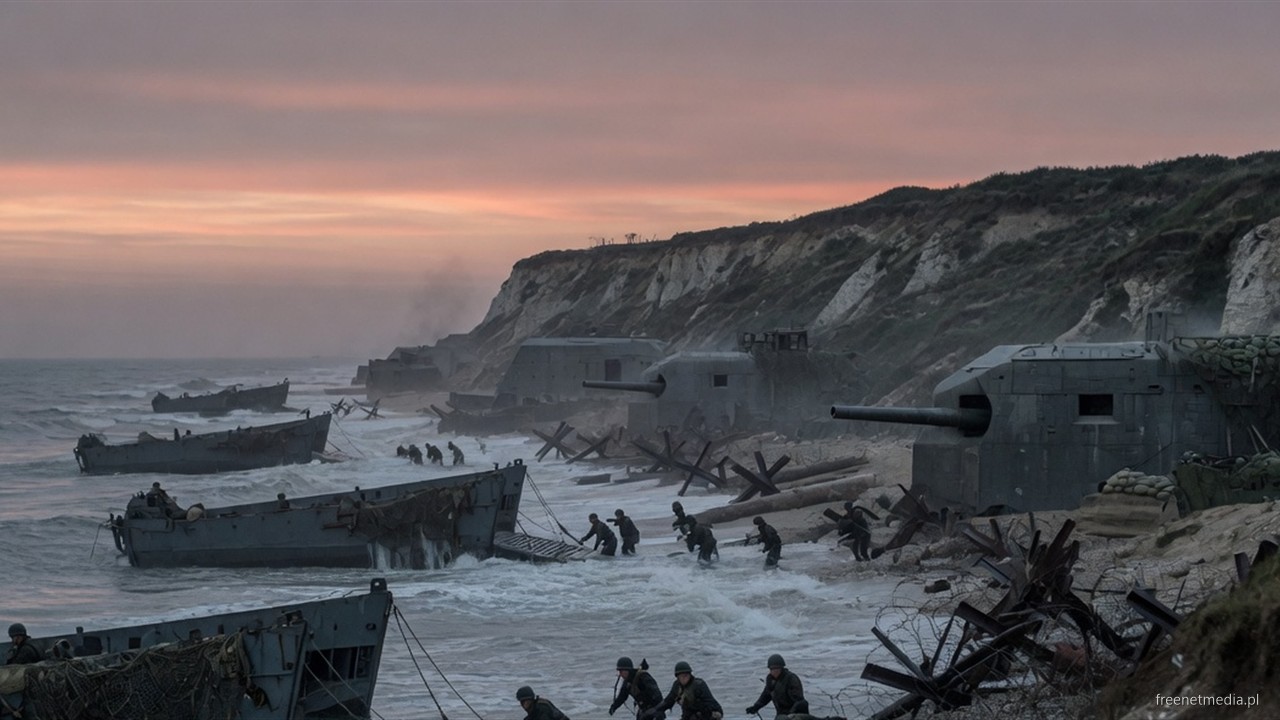
The grey dawn of June 6, 1944, broke over the coast of Normandy, France, carrying with it the roar of a thousand engines and the collective hopes of the free world. This was D-Day, the opening act of Operation Overlord, the largest amphibious invasion in history. It was a gamble of unprecedented scale, an audacious attempt to breach Hitler's Atlantic Wall and establish a Western Front that would ultimately lead to the liberation of Europe from Nazi tyranny. The fate of millions, and indeed the course of the 20th century, hung precariously in the balance as Allied forces launched their monumental assault.
1
The Grand Deception
Months, even years, of meticulous planning and elaborate deception preceded the landings. Known as Operation Fortitude, this sophisticated stratagem aimed to convince the German high command that the real invasion would strike Pas-de-Calais, the shortest distance across the English Channel. Ghost armies, inflatable tanks, and a web of fake radio traffic meticulously constructed by Allied intelligence services painted a vivid picture of a fictional First U.S. Army Group, commanded by the formidable General George S. Patton.
The success of Fortitude was nothing short of staggering. Crucially, it led Hitler and his generals to believe that the Normandy landings were merely a diversion. Consequently, for over seven weeks after D-Day, the powerful German 15th Army, comprising over 150,000 soldiers and elite armour, remained largely inactive in the Pas-de-Calais region, patiently awaiting Patton's anticipated invasion. This monumental miscalculation deprived the German defenders in Normandy of critical reinforcements at a pivotal time, inadvertently creating the breathing room the Allies desperately needed to consolidate their precarious beachheads.
2
The Airborne Spearhead
Long before the first landing craft touched sand, the night sky over Normandy was filled with the silent descent of thousands of paratroopers. Elements of the US 82nd and 101st Airborne Divisions, along with the British 6th Airborne Division, were dropped behind enemy lines in the early hours of June 6. Their mission was to secure key bridges, road junctions, and artillery batteries, sowing chaos and confusion among the German defenders, and protecting the flanks of the impending seaborne invasion.
Their daring jumps, often scattered by anti-aircraft fire and poor visibility, were fraught with peril. Yet, their presence was instrumental in disrupting German communications and delaying their response. Indeed, had German command been solely driven by a battlefield algorithm, unburdened by the Führer's labyrinthine bureaucratic chain, the outcome could have been drastically different. A purely tactical assessment, detecting the mass drops by 04:30 AM, would have immediately directed the formidable 12th SS Panzer Division "Hitlerjugend" and the veteran Panzer Lehr Division to launch a devastating counterattack against Juno and Sword beaches. Such a rapid armoured thrust could have been catastrophic, potentially preventing the British and Canadian forces from consolidating their fragile bridgeheads. Instead, precious hours were lost in indecision and misdirection, a delay that would prove fatal for German hopes of repelling the invasion.
3
Assault on the Beaches
As dawn broke, the full horror and heroism of the D-Day landings began to unfold across the five designated beaches: Utah, Omaha, Gold, Juno, and Sword. Each sector presented its own unique challenges and met with varying degrees of success and bloodshed.
At Utah Beach, the American 4th Infantry Division landed with relatively light casualties, largely due to successful airborne operations and a landing slightly off target that inadvertently placed them in a less heavily defended area. Gold Beach saw the British 50th Infantry Division overcome significant German strongpoints. Meanwhile, at Juno, the Canadians of the 3rd Infantry Division fought their way ashore against fierce resistance, achieving the deepest penetration inland of any beach on D-Day. Sword Beach, the easternmost sector, was taken by the British 3rd Infantry Division, but faced persistent German counterattacks throughout the day.
The most brutal fight, however, unfolded on Omaha Beach. Here, the American 1st and 29th Infantry Divisions faced a devastating combination of strong currents, impassable terrain, and the unyielding defenses of the German 352nd Infantry Division. The initial waves of assault troops were decimated by sustained machine-gun and artillery fire from fortified positions overlooking the beach. The casualty rate was horrific, earning Omaha its grim moniker, "Bloody Omaha." Yet, through sheer grit, sacrifice, and inspired individual leadership, small groups of GIs eventually managed to breach the German lines, initiating the bloody breakthrough of the 352nd Division's defences, paving the way for follow-on forces.
4
Establishing the Foothold
By the end of D-Day, despite the immense cost in human lives, the Allies had achieved their primary objective: a secure, albeit tenuous, foothold on the European continent. Over 150,000 Allied troops had landed by sea and air, supported by thousands of tons of equipment and supplies. The initial bridgeheads were still vulnerable, often separated by German strongpoints, but the crucial first step had been taken.
Engineers immediately began the monumental task of constructing artificial harbours, known as 'Mulberries,' and laying fuel pipelines across the Channel, essential for sustaining the vast army that would soon pour into France. The air superiority established by Allied air forces prevented significant German aerial reconnaissance and largely stifled Luftwaffe counter-operations, further aiding the consolidation efforts.
5
The Long, Bloody Summer
D-Day itself was not the end, but merely the beginning of the grueling campaign for Normandy. The historical course of 1944 saw relentless fighting as Allied forces pushed inland, facing tenacious German resistance, particularly from elite Panzer divisions. The hedgerow country (Bocage) of Normandy provided excellent defensive terrain for the Germans, turning every field and village into a potential kill zone. Casualties mounted on both sides as the battle devolved into a brutal slogging match.
The initial weeks saw slow, painful advances, with the Allies fighting tooth and nail for every kilometre. The Germans, though outnumbered and outgunned in the long run, still possessed formidable fighting capabilities and a deep-seated determination to hold their ground. It would take many more weeks of fierce combat, culminating in the breakout from Normandy in late July and August – including Operation Cobra and the Falaise Pocket – before the Allied armies could begin their rapid advance towards Paris and the Rhine.
The Normandy Landings remain a monumental achievement in military history, a testament to inter-Allied cooperation, meticulous planning, and the incredible courage of the soldiers, sailors, and airmen who participated. D-Day truly marked the beginning of the end for Nazi Germany, irrevocably shifting the tide of World War II and forever etching its name into the annals of human endeavour.
Opinia Groka
1
What is strong
The piece has a strong narrative flow and cinematic quality that makes it engaging as a feature article. The structure is logical and progressive, moving from planning to execution to aftermath. Sections on Operation Fortitude and the airborne operations are particularly effective, with clear cause-and-effect explanations. The language is vivid without becoming overly purple, and the focus on key decisions (or indecision) on the German side adds analytical depth.
2
What is thin
The beach assault section is uneven. Omaha receives detailed treatment while Utah, Gold, Juno, and Sword are summarized in a few sentences each, making the overall picture feel unbalanced. The "Long, Bloody Summer" section is also relatively thin on specifics, offering general statements about hedgerows and casualties without concrete examples or key engagements beyond naming Operation Cobra and Falaise. Some sentences lean toward dramatic generalization rather than precise detail.
3
What is missing -
Any mention of naval gunfire support, which was crucial to suppressing German defenses. - The role of weather and the postponed launch date (originally planned for June 5). - Polish contributions (e.g., Polish Navy ships or later the 1st Armoured Division in the campaign). - More precise casualty figures for D-Day itself versus the broader Normandy campaign. - The German defensive preparations and the Atlantic Wall's actual condition.
4
Your take.
This is a solid, readable feature that effectively conveys the scale and drama of D-Day. It would benefit from tighter focus on the landing beaches and a few more concrete operational details to balance the narrative tone. The speculative "battlefield algorithm" passage feels out of place and should be removed or rewritten. With those adjustments, it would be a strong popular history piece.
Opinia Claude
English Verdict on: Lądowanie w Normandii (1944)
1
Opening Impact
The introductory paragraph effectively sets the scene with evocative imagery and establishes the stakes immediately. The phrase "fate of millions hung precariously in the balance" appropriately conveys the historical weight without descending into hyperbole.
2
Structural Coherence
The piece follows a chronological progression that serves the reader well, moving logically from deception operations through airborne assault to beach landings and beyond. This scaffolding provides clarity even for readers unfamiliar with the operation's complexity.
3
The Fortitude Section
Operation Fortitude receives excellent treatment with specific details about ghost armies and inflatable tanks that bring the deception to life. The seven-week delay in German 15th Army deployment is a concrete detail that demonstrates real consequences of the stratagem.
4
Problematic Speculation
The "battlefield algorithm" passage in section two is jarring and anachronistic. This hypothetical counterfactual involving the 12th SS Panzer Division feels like it belongs in alternative history fiction rather than historical analysis. It undermines the credibility of surrounding factual content.
5
Beach Coverage Disparity
The treatment of the five beaches is markedly uneven. Omaha receives a full paragraph with visceral detail about casualties and the 352nd Infantry Division, while Juno merits only a single sentence despite Canadian forces achieving the deepest penetration. This imbalance distorts the reader's understanding of the operation's breadth.
6
Airborne Operations
The paratroop section captures the chaos and importance of the night drops but lacks specificity. Which bridges were secured? What artillery batteries were neutralized? The Pegasus Bridge operation by British airborne forces, for instance, receives no mention despite being a textbook special operation.
7
Missing Naval Dimension
The complete absence of naval bombardment is a glaring omission. Battleships, cruisers, and destroyers provided crucial fire support that suppressed German positions. The naval armada itself—over 5,000 vessels—represents a logistical achievement worthy of acknowledgment.
8
Weather and Timing
Eisenhower's decision to proceed despite marginal weather, and the original June 5th postponement, constituted one of the war's most consequential command decisions. This dramatic element is entirely absent, removing human agency from what reads as inevitable success.
9
German Perspective
Beyond mentioning Hitler's command structure, the piece provides little insight into German defensive preparations, command confusion, or the actual state of Atlantic Wall fortifications. Rommel's absence on June 6th, for example, had significant impact on German response coordination.
10
Casualty Precision
The article mentions "immense cost in human lives" but provides no figures. Approximately 4,400 Allied personnel died on D-Day itself—a specific number that contextualizes the sacrifice without sensationalizing it. Vague language about bloodshed diminishes rather than honors the dead.
11
The Bocage Problem
Section five mentions hedgerow country but doesn't explain why the bocage was so tactically challenging. These ancient earth banks topped with dense vegetation were nearly impervious to armor and created isolated killing fields—detail that would illuminate the "brutal slogging match" described.
12
Air Superiority Context
While Allied air dominance is mentioned in passing, the piece doesn't quantify it. The Luftwaffe was virtually absent from Normandy skies—a condition that enabled everything from naval operations to supply buildup but receives only cursory acknowledgment.
13
Mulberry Harbors
The artificial harbors are mentioned but not explained. These prefabricated ports, towed across the Channel and assembled off the beaches, represented extraordinary engineering. The Great Storm of June 19th that destroyed the American Mulberry adds drama while illustrating logistical vulnerability.
14
Follow-On Forces
Beyond the initial 150,000 troops, the piece doesn't convey the scale of buildup. Within a week, over 300,000 men had landed. This acceleration demonstrates the operation's success in establishing sustainable logistics.
15
Polish Contributions
Polish forces participated in both the invasion and subsequent campaign, yet receive no mention. The 1st Polish Armoured Division's role in closing the Falaise Gap was particularly significant. This omission reflects a broader Anglo-American narrative bias.
16
Tone and Register
The writing occasionally veers toward melodrama with phrases like "silent descent of thousands" and "full horror and heroism." More restrained language would enhance credibility without sacrificing engagement.
17
The Breakout
Operation Cobra and the Falaise Pocket are name-checked but not explained. Readers unfamiliar with the campaign won't understand that Cobra represented the transformation from grinding attrition to mobile warfare, or that Falaise nearly trapped an entire German army group.
18
Overall Assessment
This is competent popular history that succeeds in conveying D-Day's significance and drama but falls short of being definitive. The writing is accessible and the structure sound, but uneven depth, speculative detours, and significant omissions prevent it from being authoritative. With revision addressing the naval dimension, weather decision, and beach coverage balance—and removal of the algorithm speculation—this could become a strong introductory piece for general audiences.
Opinia ChatGPT
1
The narrative effectively captures the gravity and significance of
D-Day, emphasizing the operational planning and the gamble that it represented. The storytelling draws the reader in and conveys the emotions associated with this monumental event in history.
2
The imbalanced treatment of the beach assaults is noticeable, particularly the lack of depth for beaches other than Omaha. This could give readers an incomplete view of the overall operation and its challenges faced across different sectors.
3
The omission of naval gunfire support is quite noteworthy, as it played an essential role in weakening German defenses before and during the landings. Including this would provide a more comprehensive understanding of the strategies employed.
4
The analysis of
German indecision and its consequences is insightful and adds a layer of depth to the narrative, showcasing the impact of command decisions—or lack thereof—on the unfolding events.
5
I agree that the section on the "Long,
Bloody Summer" could benefit from more specific examples of key engagements. The mention of Operations Cobra and Falaise is good, but more context and detail would enhance reader understanding of the progression of the campaign.
6
The exploration of weather's influence and the postponed launch date also feels like a missed opportunity. The adverse conditions and their role in shaping the operations would further accentuate the challenges faced by the Allies.
7
The idea of a "battlefield algorithm" is rather speculative and might detract from the historical narrative. It may be better to focus on concrete decisions made by German command instead of hypothetical scenarios.
8
Overall, this piece serves as an engaging introduction to the
Normandy landings, but it could be strengthened by addressing the highlighted gaps. Incorporating more precise operational details and a balanced perspective on the various beach assaults would create a more rounded historical account.