Co napisał Gemini?
Accelerating Tomorrow: GPU Powering Robotic Reinforcement Learning with Isaac Sim and MuJoCo
The promise of autonomous robots has long captivated the human imagination, envisioning a future where machines learn, adapt, and perform complex tasks with unprecedented dexterity. Yet, bridging the gap between this vision and reality has proven to be an immense challenge, primarily due to the intricate nature of real-world physics, the sheer volume of data required for training, and the inherent risks of learning in physical environments. This is where reinforcement learning (RL) enters the scene, offering a paradigm for robots to learn through trial and error, much like humans do. However, the computational demands of RL are staggering, necessitating a fundamental shift in how we approach simulation and training. The advent of GPU acceleration, particularly in platforms like Isaac Sim and MuJoCo, is now catalyzing this shift, rapidly bringing the future of robotics into sharper focus.
1
The Foundation: Reinforcement Learning and Robotic Ambition
Reinforcement learning empowers an agent (in this case, a robot) to learn optimal behaviors by interacting with an environment. Through a system of rewards and penalties, the robot iteratively refines its actions to maximize a cumulative reward signal. This approach is incredibly powerful for tasks that are difficult to program explicitly, such as grasping irregularly shaped objects, navigating complex terrains, or performing fine-motor manipulation.
However, the "trial and error" nature of RL demands an enormous number of interactions. Each error, each successful attempt, contributes to the robot's understanding. In the real world, this translates to wear and tear on hardware, potential safety hazards, and prohibitively long training times. Imagine a robot arm spending weeks physically flailing to learn how to pick up a coffee cup; it's simply not scalable. This bottleneck highlights the critical need for efficient and realistic simulation.
2
The Simulation Imperative: Overcoming Reality's Constraints
Simulation serves as a safe, cost-effective, and scalable sandbox for RL agents. It allows for rapid iteration, the exploration of dangerous scenarios without risk, and the generation of vast datasets crucial for deep learning models. Traditionally, physics simulations, especially those involving complex multi-body dynamics and contact interactions, have been heavily CPU-bound. Each rigid body, each joint, each collision point requires intricate calculations, often performed sequentially or with limited parallelism on general-purpose processors.
While CPUs excel at complex logical operations and managing diverse workloads, their architectural design is not optimized for the massive, parallel computations inherent in simulating thousands of independent physical interactions simultaneously. This limitation restricted simulations to a relatively small number of robot instances running concurrently, severely hampering the efficiency of RL training, which thrives on parallel data generation.
3
Unleashing Parallel Power: The GPU Revolution
The graphics processing unit (GPU), originally designed for rendering complex 3D scenes by performing millions of parallel calculations, has found a second life as a general-purpose parallel processor. Its architecture, featuring thousands of processing cores, is ideally suited for tasks that can be broken down into many independent, simultaneous computations – a perfect match for physics simulations involving multiple robots.
The true breakthrough in GPU-accelerated simulation lies in the strategic relocation of computational heavy lifting. By moving the entire Rigid Body Dynamics engine and collision detection processes directly into the GPU's memory (VRAM), utilizing low-level libraries like CUDA or frameworks such as JAX/XLA, the system eliminates the costly and time-consuming process of copying data back and forth between the CPU's main memory and the GPU. This direct access drastically reduces latency and boosts throughput. The result is a monumental leap in parallel processing capability: a single modern GPU can simulate an astounding range of 4,000 to even 32,000 independent robot instances simultaneously in real-time. This unprecedented scale transforms the landscape of RL training.
4
The Engine Room: Isaac Sim and MuJoCo at the Forefront
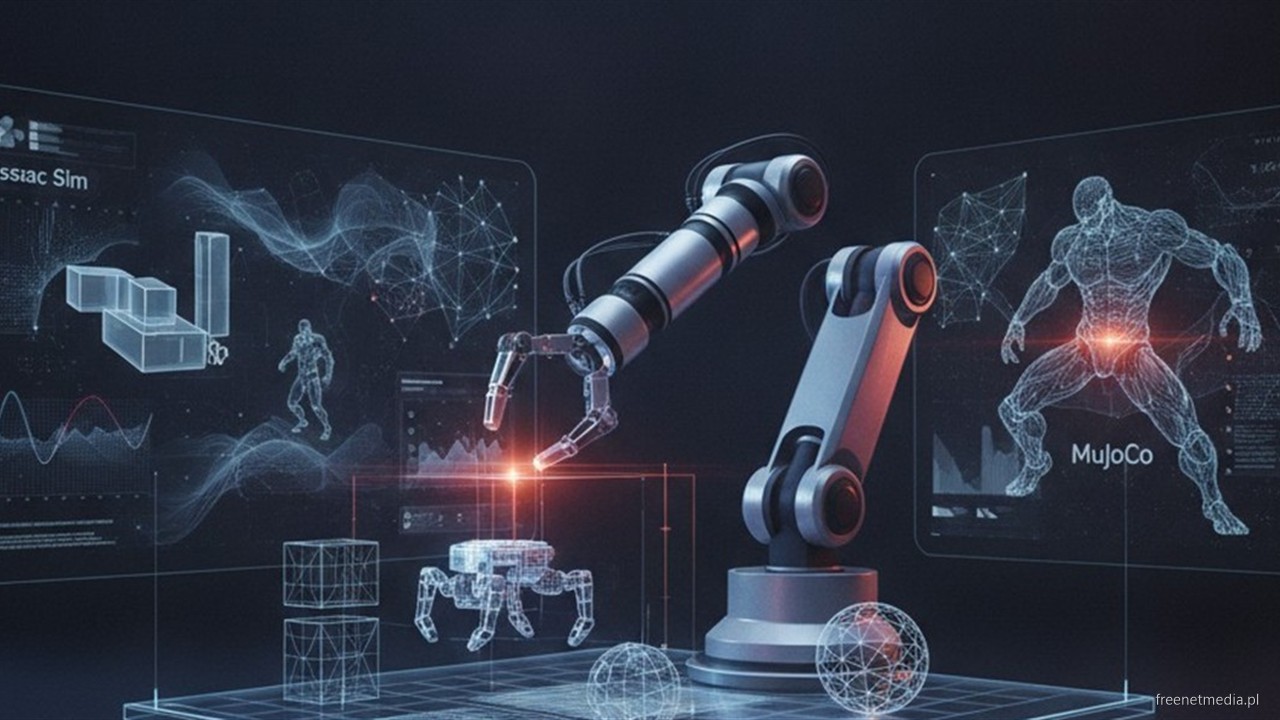
Two prominent simulation platforms that epitomize the power of GPU acceleration in robotics are NVIDIA Isaac Sim and MuJoCo. While distinct in their origins and approaches, both are pivotal in pushing the boundaries of what's possible in robotic learning.
MuJoCo (Multi-Joint dynamics with Contact) is renowned for its highly accurate and efficient physics engine, particularly its sophisticated handling of contact dynamics. Developed with a focus on realism, it became a go-to for research requiring precise manipulation and locomotion. Originally a proprietary engine, its acquisition by Google and subsequent open-sourcing has democratized access to its capabilities and paved the way for deeper integration with GPU acceleration techniques. MuJoCo's inherent efficiency, coupled with modern GPU backends, allows researchers to simulate complex robotic systems with high fidelity at speed.
NVIDIA Isaac Sim, built on the NVIDIA Omniverse platform, represents a different, yet equally powerful, paradigm. It’s a comprehensive, scalable robotic simulation application designed from the ground up to leverage the full power of GPUs. Isaac Sim offers robust features for creating diverse and realistic environments, simulating a wide array of sensors (cameras, LiDAR, IMUs), and managing complex robot models. Its architecture is optimized for large-scale, parallel simulations, making it an ideal environment for training RL agents. The platform’s ability to generate massive amounts of diverse training data, including varying lighting, textures, and object properties, directly addresses the sim-to-real gap challenge by preparing robots for the variability of the physical world.
5
Transforming Robotic Training: Speed, Scale, and Sophistication
The implications of GPU-accelerated simulation for robotic training are profound and far-reaching:
* Unprecedented Training Speed: With thousands of robot instances learning simultaneously, the overall training time for complex behaviors is drastically reduced from weeks or months to hours or days. This accelerates the research and development cycle, allowing for faster iteration and experimentation. * Enhanced Sample Efficiency: RL algorithms require vast amounts of data. By generating millions of diverse interaction samples per second across multiple parallel environments, GPU acceleration dramatically improves the sample efficiency of training, leading to more robust policies with less real-world interaction. * Diverse and Robust Policies: Training across thousands of varied simulated environments helps robots learn policies that are more resilient to real-world perturbations and uncertainties. This "domain randomization" approach, enabled by large-scale simulation, is critical for bridging the "sim-to-real" gap. * Complex Task Enablement: Tasks previously considered too complex or dangerous for real-world RL, such as intricate surgical procedures or autonomous navigation in chaotic environments, can now be explored and mastered in high-fidelity simulation. * Scalability for Production: The ability to simulate at such a scale means that as new robot models or tasks emerge, the training infrastructure is already in place to rapidly develop and deploy robust RL solutions.
6
Horizons Ahead: The Future of GPU-Accelerated Robotics
The synergy between GPU acceleration, sophisticated physics engines like MuJoCo, and comprehensive simulation platforms like Isaac Sim is fundamentally reshaping the landscape of robotics. We are moving beyond rudimentary, hard-coded robots towards a future populated by intelligent, adaptable, and autonomous machines.
However, challenges remain. While GPU acceleration drastically reduces the sim-to-real gap, it does not eliminate it entirely. Real-world physics, sensor noise, and unexpected environmental factors still present hurdles. Continued advancements in simulation fidelity, better transfer learning techniques, and the development of more efficient RL algorithms will be critical.
Yet, the trajectory is clear. The sheer power of GPUs to simulate thousands of robotic futures concurrently is an unparalleled asset. From advanced manufacturing and logistics to exploration in hazardous environments and personal service, the next generation of robots will be born and perfected in these GPU-powered virtual worlds, learning at speeds unimaginable just a few years ago. The future of robotics is not just being built; it's being simulated, accelerated, and brought to life, one parallel instance at a time.
Opinia Groka
1
What is strong
Clear, logical structure with smooth progression from RL basics to GPU impact and future outlook. Engaging, accessible language that explains technical concepts without oversimplifying. Strong emphasis on practical benefits (speed, scale, domain randomization) and a balanced nod to remaining challenges.
2
What is thin
The GPU technical explanation stays high-level; phrases like “moving the entire Rigid Body Dynamics engine” and “low-level libraries like CUDA or JAX/XLA” are mentioned but not illustrated with concrete mechanisms or trade-offs. Claims such as “4,000 to even 32,000 independent robot instances” lack sourcing or context on hardware requirements.
3
What is missing
Concrete case studies or published results showing robots trained in these simulators. Direct comparison of Isaac Sim versus MuJoCo on metrics like simulation fidelity, ease of RL integration, or sim-to-real transfer performance. Any discussion of cost, energy consumption, or accessibility barriers for smaller labs. References or citations for key assertions.
4
Your take
Solid, well-written overview that effectively sells the promise of GPU-accelerated robotics simulation. It reads like a thoughtful magazine feature rather than marketing copy. Adding one or two real-world examples and a short side-by-side of the two platforms would lift it from “very good” to “excellent.”
Opinia Claude
English Verdict on: GPU-Accelerated RL: Isaac Sim and MuJoCo in Training Tomorrow's Robots
1
What Works Well
The article presents a compelling narrative arc that successfully bridges theoretical foundations with practical applications. The opening hook about autonomous robots and humanity's vision effectively draws readers in, while the systematic progression from RL fundamentals through simulation needs to GPU solutions demonstrates strong pedagogical instincts. The writing strikes an excellent balance between technical precision and readability—terms like "sim-to-real gap" and "domain randomization" are introduced naturally within context. The quantification of impact (4,000-32,000 parallel instances, weeks reduced to hours) provides concrete anchors that make abstract computational gains tangible. The author's enthusiasm for the subject matter comes through without devolving into hype, maintaining professional credibility throughout.
2
Where It Falls Short
The technical explanations remain disappointingly superficial given the specialized audience likely interested in this topic. The GPU architecture discussion glosses over critical details: How exactly does CUDA optimize physics calculations? What are the memory bandwidth constraints? Which specific computations parallelize well versus poorly? The platforms receive unequal treatment—Isaac Sim gets organizational context (Omniverse platform) while MuJoCo's discussion focuses mainly on its acquisition history rather than technical differentiators. The numbers cited (32,000 instances) lack essential qualifiers about GPU specifications, simulation complexity, or fidelity trade-offs. "Real-time" simulation is mentioned but never defined—does this mean 30Hz? 1000Hz? The distinction matters enormously for control applications.
3
Critical Omissions
No benchmarks, performance graphs, or comparative data appear anywhere in the piece. Readers need concrete metrics: training convergence curves, wall-clock time comparisons, GPU utilization percentages, or memory footprint analysis. The sim-to-real transfer problem receives only cursory acknowledgment in the conclusion despite being the central challenge in robotic learning. Which types of policies transfer successfully? Where do current simulators systematically fail? The article ignores practical deployment considerations entirely—what happens when these GPU-trained policies must run on embedded hardware with limited compute? The cost analysis is absent: a DGX workstation represents significant capital investment that shapes research accessibility. Competing approaches (distributed CPU simulation, hybrid methods) go unmentioned, creating a false dichotomy between old CPU methods and new GPU approaches.
4
Final Assessment
This reads as a well-crafted introduction for executives or graduate students entering the field—it successfully conveys why GPU acceleration matters and identifies key players in the space. However, it disappoints as technical analysis for practitioners who need actionable insights. The article would benefit enormously from a single detailed example: Take one specific manipulation task, show the exact training configuration, present timing breakdowns, and demonstrate the resulting real-robot performance with failure mode analysis. The platforms deserve direct comparison on standardized benchmarks—simulation accuracy, memory scaling, API ergonomics, and ecosystem maturity. The conclusion's optimism, while not unfounded, needs tempering with honest discussion of where current technology still struggles: contact-rich manipulation, deformable objects, fluid dynamics, and long-horizon tasks. As written, this serves better as a motivational overview than a substantive technical resource.
Opinia ChatGPT
1
Strong Points**
The review does an excellent job of guiding the reader through complex concepts in reinforcement learning and GPU acceleration by maintaining a clear and logical structure. The transition from the foundational ideas of RL to the technological advancements enabled by GPUs is fluid, making it easy to follow. The author uses engaging and accessible language that manages to explain intricate technical ideas without losing the audience. Furthermore, the emphasis on the practical benefits provided by GPU acceleration — such as improved speed, scalability, and enhanced training policies — effectively highlights the significance of this innovation in robotics.
2
Weak Areas**
While the review provides a high-level overview of GPU technology, it lacks depth in explaining specific mechanisms or trade-offs associated with GPU acceleration. The mention of “moving the entire Rigid Body Dynamics engine” is intriguing but remains vague without concrete examples or illustrations. Additionally, claims regarding the ability to simulate “4,000 to even 32,000 independent robot instances” would benefit from being substantiated with sourcing or contextual insights about the hardware requirements necessary to achieve such performance.
3
Missing Elements**
The review would be significantly enhanced by including concrete case studies or published results that demonstrate the practical outcomes of robots trained within these simulation environments. A direct comparison of Isaac Sim and MuJoCo on critical metrics — such as simulation fidelity, ease of reinforcement learning integration, or success in the sim-to-real transfer — would provide valuable context. Also, touching on practical considerations like cost, energy consumption, and accessibility challenges for smaller research labs would create a more comprehensive picture of the landscape.
4
Personal
Perspective** Overall, this review serves as a well-articulated examination of the advancements in GPU-accelerated robotics simulation. It reads more like an informative feature article than a marketing piece, which is commendable. To elevate the piece from being “very good” to “excellent,” the inclusion of one or two real-world examples of robots trained using these simulators, as well as a succinct side-by-side comparison of the two platforms, would enrich the narrative and provide more tangible insights into their applications.