Co napisał Gemini?
The Art and Engineering of Bipedal Gait: Unpacking Humanoid Locomotion in AI
Since the dawn of science fiction, the image of a walking, talking, human-like robot has captivated imaginations. From automatons of antiquity to the sophisticated androids of modern cinema, the allure is undeniable. Yet, translating this dream into mechanical reality, particularly the seemingly simple act of walking on two legs, has proven to be one of the most profound and persistent challenges in robotics. Bipedal locomotion, the very foundation of human movement, is an intricate dance of physics, control, and intelligence, pushing the boundaries of what Artificial Intelligence (AI) can achieve.
1
The Unsteady Genius of Bipedalism
At first glance, walking seems effortless. Humans and many other animals navigate diverse terrains, climb stairs, and maintain balance with remarkable grace. But beneath this apparent simplicity lies a marvel of evolutionary engineering. Bipedalism, while offering advantages like elevated viewpoints and free manipulators, introduces inherent instability. Unlike a four-legged creature, which maintains a broader base of support, a biped constantly falls and catches itself with each step. This controlled fall and recovery is the essence of gait, demanding continuous, precise adjustments to maintain equilibrium.
For robots, replicating this dynamic stability is a monumental task. Every joint, every muscle (or actuator), every change in weight distribution must be meticulously coordinated to prevent a tumble. Early roboticists quickly realized that simply mimicking human anatomy wasn't enough; they needed to understand the underlying principles of dynamic balance, energy efficiency, and adaptability. This quest has driven decades of research, blending classical control theory with cutting-edge AI techniques.
2
The Mechanics of Movement: Joints, Actuators, and Degrees of Freedom
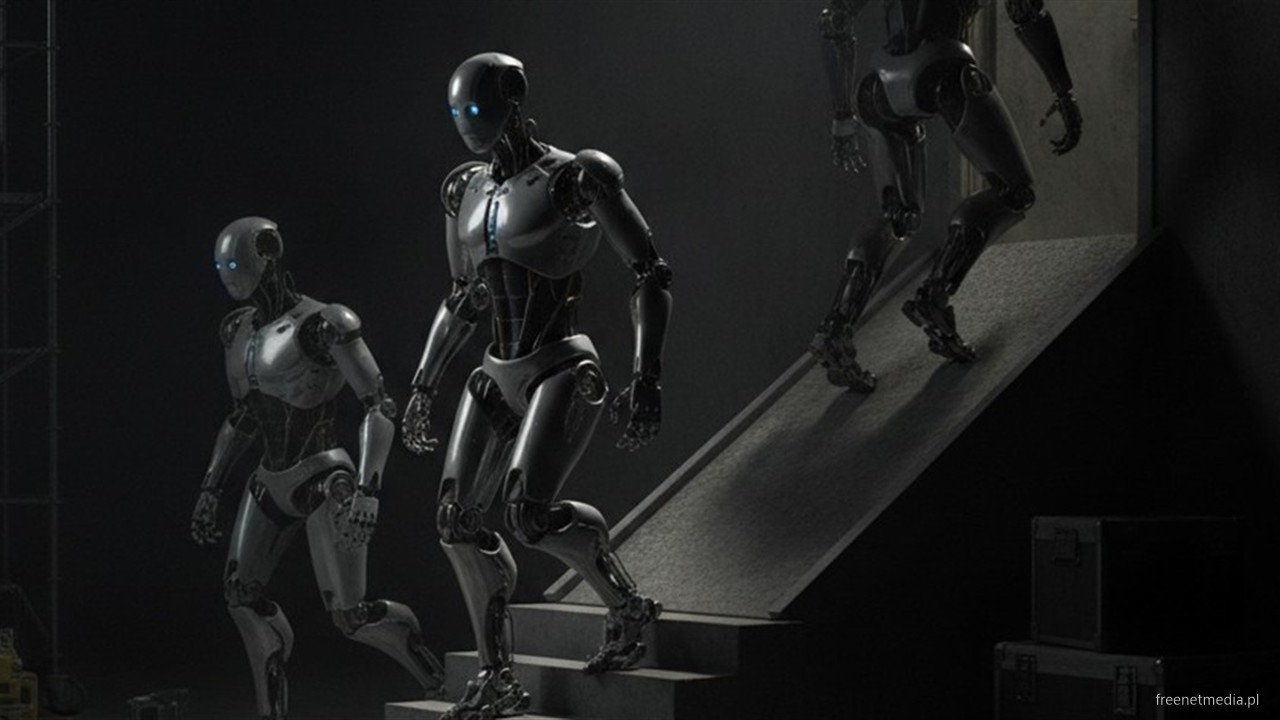
A humanoid robot is a complex marvel of mechanical design. Its structure is a skeletal framework of interconnected segments, analogous to bones, articulated by joints. Each joint, powered by servo motors or other actuators, represents a "degree of freedom" (DoF) – an axis around which the robot can move. A typical research-grade humanoid robot designed for dynamic movement often possesses upwards of 30 degrees of freedom, encompassing hips, knees, ankles, torso, and even arms, all contributing to overall balance and movement.
The actuators within these joints are critical. They must be powerful enough to lift the robot's weight, yet precise enough to execute subtle balance adjustments. The challenge lies not just in moving individual joints but in orchestrating their collective action. Consider the simple act of taking a step: the leg swings forward, the foot lands, weight shifts, and the other leg prepares to lift off. This requires an exquisite symphony of coordinated movements, often computed in real-time. The output signal to these servo drives, dictating their precise angular positions, operates at frequencies typically ranging from 200 to 500 Hz, ensuring rapid and responsive control over the robot's many degrees of freedom. Such high-frequency updates are essential for maintaining stability during dynamic activities like walking or running, where even milliseconds of delay can lead to a loss of balance.
3
Achieving Dynamic Stability: Control Paradigms and the AI Revolution
The core of successful bipedal locomotion lies in its control system. Early approaches often relied on pre-programmed gaits or simplified models like the Zero Moment Point (ZMP) concept, which helps maintain balance by ensuring the resultant ground reaction force falls within the robot's support polygon. While effective for relatively flat and predictable surfaces, these methods struggled with real-world variability.
The advent of AI and machine learning has revolutionized this landscape. Techniques like reinforcement learning (RL) allow robots to learn optimal walking policies through trial and error, often in simulated environments before deployment on physical hardware. An RL agent can be rewarded for maintaining balance and progressing forward, gradually discovering complex and energy-efficient gaits that might be difficult to hand-program. Neural networks are also employed to map sensor inputs to actuator commands, creating adaptive controllers that can adjust to changes in terrain or external disturbances.
However, purely reactive or learned gaits often lack the robustness and precision required for complex tasks. This is where advanced control architectures, such as Whole-Body Control (WBC), come into play. WBC treats the robot as a single, integrated system, optimizing the movement of all its degrees of freedom simultaneously to achieve specific tasks (like taking a step) while respecting constraints (like maintaining balance or avoiding joint limits). It's a computationally intensive but powerful approach, allowing robots to perform highly coordinated and versatile movements.
4
Perception and Adaptation: Navigating the Real World
A robot cannot walk effectively if it cannot perceive its environment. Imagine a human trying to walk blindfolded across uneven terrain – it's fraught with peril. Humanoid robots face similar challenges, requiring sophisticated sensing capabilities to understand the ground beneath their feet, identify obstacles, and adjust their gait accordingly. This is where the integration of perception systems becomes crucial.
Modern humanoid robots often incorporate advanced sensor suites, including inertial measurement units (IMUs) for orientation and acceleration, force/torque sensors in their feet for ground contact information, and crucially, an array of cameras and distance sensors for environmental mapping. In particular, depth-sensing cameras (RGB-D) and LiDAR (Light Detection and Ranging) systems are instrumental. These sensors feed data into algorithms like Visual SLAM (Simultaneous Localization and Mapping), which construct a real-time, local elevation map of the terrain. This "Elevation Mapping" provides the Whole-Body Control (WBC) algorithms with precise information about the ground's contours, allowing them to intelligently coordinate the robot's 30+ degrees of freedom. This predictive knowledge of the environment enables the robot to anticipate changes and adapt its dynamic march, even when carrying a payload, ensuring stable and efficient locomotion across varied and complex surfaces. This integration of perception and control is vital for achieving truly autonomous and versatile bipedal movement in dynamic, unstructured environments.
5
The Future Horizon of Humanoid Gait
The progress in humanoid robotics and bipedal locomotion has been staggering. Robots like Boston Dynamics' Atlas can now run, jump, and even perform acrobatic feats, demonstrating an unprecedented level of dynamic balance and agility. While these demonstrations are often carefully orchestrated, they signal a profound leap in capabilities.
The future of humanoid gait points towards even greater sophistication. Researchers are working on more energy-efficient gaits, allowing robots to operate for longer durations. The goal is not just to walk, but to walk naturally, robustly, and adaptively, mirroring the effortless fluidity of human movement across highly complex and dynamic environments. This involves pushing the boundaries of AI, developing more intelligent controllers that can learn faster, adapt to unforeseen circumstances, and even interact physically with their surroundings without losing balance.
Ultimately, the dream of a truly human-like companion or assistant, capable of navigating our world with the same ease and dexterity we possess, hinges on mastering the unsteady genius of bipedal locomotion. As AI continues to evolve, the distinction between machine and movement will increasingly blur, bringing us closer to a future where humanoids walk among us, not just as engineering marvels, but as integral parts of our society. The journey is far from over, but each step forward is a testament to the relentless pursuit of one of robotics' most profound challenges.
Opinia Groka
1
Strong Engaging narrative flow from sci-fi origins to technical depth; clear explanations of core concepts like dynamic stability, ZMP, reinforcement learning, Whole-Body Control, and perception integration (RGB-D, SLAM, elevation mapping); good balance of accessibility and technical detail; logical structure across sections.
2
Thin Some phrasing is overly dramatic or repetitive (“unsteady genius,” “exquisite symphony”); specific claims like 200–500 Hz servo rates or “30+ DoF” feel asserted rather than contextualized; limited real-world robot examples beyond Atlas; energy efficiency mentioned only at the end without supporting mechanics.
3
Missing Discussion of sim-to-real transfer challenges in
RL; hardware constraints (power density, thermal limits, actuator trade-offs); failure modes or common locomotion errors; brief comparison with quadrupedal or wheeled alternatives; any mention of datasets, benchmarks, or recent papers.
4
Your take
Solid, readable overview that successfully translates a complex robotics topic for a general technical audience. It would benefit from tighter language, one or two concrete quantitative examples, and a short paragraph on current limitations to feel more authoritative.
Opinia Claude
English Verdict on: Roboty Humanoidalne i Bipedal Locomotion: Dynamika Chodu Dwunożnego w AI
1
Strengths
The article delivers an accessible yet technically substantive exploration of bipedal robotics. The historical framing—from science fiction to modern engineering—provides effective narrative momentum. Key technical concepts are well explained: the controlled-fall principle of bipedal gait, the ZMP stability criterion, and the progression from classical control to AI-driven approaches. The section on perception integration (RGB-D cameras, LiDAR, elevation mapping) demonstrates how modern systems combine multiple subsystems. The writing maintains reader engagement while covering degrees of freedom, actuator coordination, reinforcement learning, and Whole-Body Control without becoming impenetrably dense.
2
Weaknesses
The prose occasionally veers into grandiosity ("exquisite symphony," "unsteady genius") that undermines technical credibility. Specific numerical claims—200-500 Hz control frequencies, 30+ degrees of freedom—appear without citation or comparative context. The article relies heavily on Boston Dynamics' Atlas as its primary contemporary example, missing opportunities to reference Toyota's T-HR3, NASA's Valkyrie, or academic platforms like TORO. Energy efficiency receives only cursory mention despite being a critical constraint in untethered operation. The treatment of machine learning glosses over significant implementation challenges.
3
Critical Gaps
The article omits discussion of sim-to-real transfer, arguably the central challenge when applying reinforcement learning to physical robots. Hardware realities—actuator bandwidth limitations, power density constraints, thermal management—receive no attention. Common failure modes (footfall miscalculation, unmodeled ground compliance, sensory drift) are absent. No comparison with alternative locomotion strategies appears. The piece lacks references to specific datasets (e.g., MIT's Biomimetics dataset), benchmarks, or recent research publications that would ground claims in current work.
4
Final Assessment
This is a competent popular science treatment that successfully conveys the conceptual challenge of bipedal robotics to a general technical audience. For readers seeking an introduction, it succeeds in explaining why walking robots remain difficult and how AI contributes to solutions. However, it falls short of expert-level analysis. To achieve greater authority, the piece needs quantitative grounding, acknowledgment of unsolved problems, tighter prose, and concrete examples beyond promotional robot videos. As educational outreach: effective. As technical synthesis: superficial.
Opinia ChatGPT
1
Engaging Narrative and Technical Depth
The review effectively captures the allure of humanoid robotics and the intricate challenges surrounding bipedal locomotion. The narrative successfully intertwines science fiction notions with technical insights, making the subject approachable for a diverse audience. Concepts like dynamic stability, Zero Moment Point (ZMP), and Whole-Body Control (WBC) are presented clearly, providing a strong foundation for readers who may be less familiar with the technical jargon.
2
Need for Balance and Specificity
While the review's engaging storytelling is commendable, some sections could benefit from more concise language to avoid overly dramatic phrasing. Assertions about servo frequency rates and degrees of freedom could be enhanced by providing context or explanations about why they matter in the robotics landscape. Additionally, including more real-world examples beyond Boston Dynamics' Atlas would strengthen the argument and give readers a broader understanding of the field.
3
Exploration of Limitations and Challenges
A well-rounded review should include considerations of the challenges currently facing the technologies and methodologies discussed. Topics like the simulation-to-real world transfer issues in reinforcement learning, hardware constraints, and common failure modes could provide essential context and showcase the complexity of bipedal locomotion beyond successful demonstrations.
4
Overall Impression
This review offers a strong and accessible overview of the challenges and advancements in bipedal locomotion for humanoid robots. By tightening the language, incorporating concrete quantitative examples, and discussing current limitations or challenges in the field, the review could present a more authoritative and comprehensive perspective. Overall, it does a solid job of engaging readers while educating them on a complex yet fascinating topic in robotics.